







Home
- Innovations with impact
- Advancing medicine with high-impact AI solutions
Advancing medicine with high-impact Healthcare AI
Healthcare AI is transforming lives — everywhere, every day. At Siemens Healthineers, we are at the forefront of this transformation, researching and developing AI-powered solutions that deliver tangible improvements in patient care. As one of the world’s leading MedTech companies, we focus on turning technological progress into real-world clinical impact.
What kind of Healthcare AI do we research and develop?
Our Healthcare AI efforts are strategically centered on key clinical indications, including cardiovascular diseases, cancer, and neurological disorders. In these highly complex and high-impact areas, AI can help address some of healthcare’s most pressing challenges supporting better decisions, improving outcomes, and advancing care at scale.
Elevating patient care
From AI in patient care to procedure automation and digital health, we're helping healthcare organizations worldwide harness the benefits of artificial intelligence in healthcare delivery.
Our innovation is structured around three core areas spanning the full continuum of care: the automation of procedures, the coordination of care, and the orchestration of healthcare systems.
Algorithms, foundational models, and agentic AI
To translate innovation into clinical and economic value, our AI pipeline covers the full lifecycle — from data curation, reading, and annotation to research and development, model training, and the translation of models into scalable businesses. This pipeline includes both large foundational models and more specialized models tailored to specific clinical tasks.
Healthcare AI is fundamentally a question of scale where compute power, data, and scientific expertise converge. Over the past decade, available compute power has increased by a factor of 1,000, enabling entirely new approaches to AI development in medicine.
Going beyond individual algorithms, we advance foundational and agentic AI models to enable end-to-end workflow efficiencies across clinical environments. These technologies reduce the burden on healthcare professionals, strengthen operational resilience in hospitals, and support more sustainable care delivery.
What is required to develop Healthcare AI?
Access to comprehensive and diverse health data is essential for advancing Healthcare AI. Siemens Healthineers meticulously curates high-quality datasets from all five continents, drawing on public clinical registries, medical associations, and trusted research partners. These datasets span a wide range of modalities, including clinical imaging, laboratory data, genomic information, and longitudinal clinical data such as patient histories reflecting the diversity and complexity of realworld healthcare systems and patient populations.
At the same time, one of the greatest challenges in healthcare remains its high degree of fragmentation across data sources, patient records, and systems that are difficult to connect and integrate. In many cases, this fragmentation exists for good reasons. Stringent data protection requirements and regulatory safeguards are essential to protect patient safety and prevent harm. Rigorous validation and approval processes are therefore not optional; they are fundamental.
Smart way to overcome data silos
Our approach is to overcome these barriers responsibly, focusing not only on risk prevention, but on unlocking the full potential of innovation. Technologies such as federated learning enable us to train AI models across distributed data sources without transferring or centralizing sensitive patient information. This allows us to integrate insights from diverse datasets while fully respecting data privacy regulations and data sovereignty. As these technologies continue to mature, they are helping to overcome longstanding constraints and enable trusted, scalable innovation in Healthcare AI.
A practical way to make this tangible for customers is Digi X-Lab: a secure, local innovation environment that helps clinical partners explore, validate, and scale AI use cases without moving sensitive data outside their trusted infrastructure.
A global infrastructure enabling our research and development
At the heart of our AI development is a global team of more than 350 highly skilled experts who design, train, and rigorously validate our AI algorithms. Their work is supported by a dedicated global computing infrastructure tailored for largescale AI experimentation.
Our flagship supercomputer, Sherlock, is among the most powerful AI development platforms in the healthcare industry. Its exceptional compute capacity enables more than 1,800 AI experiments per day, accelerating continuous innovation in AI powered healthcare solutions. Sherlock operates in the United States and is complemented by a decentralized infrastructure spanning China, Germany, and India, ensuring global scalability, resilience, and compliance.
How do we ensure our Healthcare AI is compliant and safe?
Trust, safety, and compliance are foundational to our Healthcare AI development. Siemens Healthineers adheres to stringent data privacy principles to ensure that patient information is always protected. Before any data is used in research or development, it undergoes rigorous, standardized anonymization processes that remove all personally identifiable information — often before the data even reaches Siemens Healthineers. This approach safeguards patient privacy while enabling responsible innovation.
High‑quality data is essential for safe and reliable AI. Our experts carefully review and enrich each dataset, adding clinically relevant context such as anatomical landmarks, diagnostic indicators, or tumor characterizations where appropriate. These high‑quality annotations are critical for developing AI models that are accurate, robust, and clinically meaningful.
Research and development follow a strict AI governance framework
At the core of our AI development lies an ever‑growing, carefully governed data foundation comprising more than two billion data points. This comprehensive data ecosystem enables us to continuously refine our algorithms, deepen our understanding of diseases and patient populations, and improve model performance over time. With every additional data point, our AI becomes more precise, resilient, and clinically relevant.
Algorithms can automate routine tasks, and that’s a great asset when it comes to making healthcare more efficient and effective. We focus on developing scalable solutions that help physicians improve the quality of diagnostics and therapies, especially in the areas of cardiology, neurology, and oncology. To identify valuable innovations that can be integrated in clinical routines, we collaborate with leading medical institutions around the world.
AI relies on accessing and correlating a large amount of high-quality data. The data models incorporate factors like state of health, medical results, and clinical studies. Clinical standards for treatments defined by medical associations are also used to develop computational models and their architecture. Our work primarily focuses on key clinical indications like cardiovascular diseases, cancer, and neurological diseases.
Algorithms are computational models created by a team of data engineers, medical scientists, and programming experts. Each application is uniquely designed to answer a specific question and automate its clinical routine process. Basically, it compares the (health) data with the probability of (clinical) outcomes. We hold over 1,300 patent families related to machine learning, with more than 750 of these pertaining to deep learning.
We develop scalable AI-powered solutions, and that’s why we maintain a robust infrastructure that includes supercomputing capabilities and a data lake. The quality and volume of the data used for training directly impact the accuracy and effectiveness of the algorithm's predictions.
The algorithm and its performance undergo a government-regulated testing and approval process. We also have to demonstrate the safety and benefits of the algorithm in patient treatment.
The algorithm is embedded in a software solution or device. If the algorithm and its application have been validated, it can be implemented and used in clinical routines.
The final step involves monitoring the performance of the AI in clinical routines and updating the computational models as medical advances are made. This ensures that the algorithms continue to perform optimally and remain relevant in the ever-evolving field of medicine.
Our AI models draw on a broad and diverse range of data sources, including patient health information, medical results, clinical studies, and established clinical treatment standards defined by medical associations. Every dataset follows a strict governance framework to ensure data integrity, traceability, and security. Each data point originates from a real patient. Thus, protecting patients’ rights, privacy, and trust remains paramount. This unwavering commitment to compliance and safety underpins every AI solution we bring to clinical practice.
Which impact does Healthcare AI have today?
Healthcare AI is no longer a future promise. It is already embedded in hospitals around the world, quietly transforming clinical routines. Integrated into daily practice, AI supports healthcare professionals by automating tasks, augmenting clinical decision-making, and optimizing the use of limited resources. In doing so, it delivers tangible value every day — for clinicians, patients, and healthcare systems alike. Across clinical environments, Healthcare AI accelerates procedures, strengthens coordination across the patient journey, and expands access beyond individual departments or diseases.
Supporting clinicians and accelerating care delivery
Global demand for medical procedures continues to rise, while workforce shortages remain one of the most pressing challenges facing healthcare systems. Healthcare AI helps address this imbalance by improving efficiency across individual workflow steps as well as entire procedures.
Deep Resolve
Autocontouring
Operational twinning
Healthcare AI eases the workload of healthcare professionals and simplifies device operation by automating routine and repetitive tasks. Faster exams, accelerated image interpretation, streamlined therapy planning, and more efficient sample handling enable providers to treat more patients without increasing staffing pressure. At the same time, Healthcare AI reduces variability between users, contributing to more consistent and reproducible clinical outcomes.
Enhancing the patient journey from screening to survivorship
Healthcare AI improves care not only at isolated clinical touchpoints, but across the entire patient journey. By intelligently integrating patient context over time, Healthcare AI helps to make care more proactive, predictive, and personalized.
Clinically, Healthcare AI supports longitudinal care by enhancing image quality, enabling comprehensive assessment of imaging studies, and automatically identifying clinically relevant findings. It also supports therapy planning and guidance by enabling the intelligent generation of personalized treatment plans and by integrating relevant diagnostic data directly into therapy workflows. Together, these capabilities make it possible to deliver more individualized care at scale — even as case complexity and patient volumes continue to grow.
Expanding access and strengthening healthcare delivery at scale
Beyond individual workflows, Healthcare AI enhances performance at the departmental, fleet, and institutional level, helping healthcare providers operate more efficiently and reliably as systems.
By prioritizing information and intelligently analyzing data, Healthcare AI supports more effective scheduling of patients and resources, improving capacity allocation across departments. Predictive services enhance equipment performance and uptime, while AI‑powered operational twinning helps streamline complex hospital processes and identify opportunities for improvement before bottlenecks occur.
Across automation, coordinated care, and system-level orchestration, Healthcare AI delivers measurable improvements in real clinical environments. Embedded in daily routines, it acts as a trusted teammate — helping healthcare professionals treat more patients, with greater consistency and quality, while strengthening the resilience and sustainability of healthcare systems.
Improving workflows
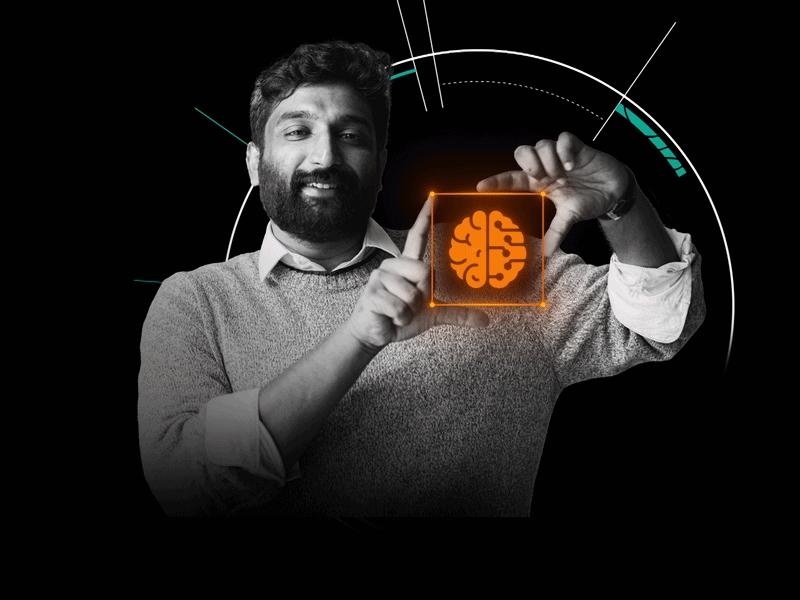
Both companies and hospitals face similar challenges. Ullas Poikavila develops AI solutions for better workflows — and shows why people must remain the central focus.
How is Healthcare AI transforming the future of medicine?
Healthcare is inherently complex and it must respond to individual needs, because no two patients are alike. Even within the same medical indication, diseases can develop in very different ways and present with widely varying characteristics. This is where Healthcare AI becomes transformative.
In the future, Healthcare AI will broadly orchestrate healthcare processes seamlessly in the background. Digital twins will serve as continuous virtual companions, linking individual patient data with clinical insights across the entire care journey.
By predicting treatment pathways and recommending personalized interventions, Healthcare AI will enable better, team‑based clinical decisions while quietly reducing complexity, workload, and friction in everyday clinical practice.
With Healthcare AI, medical professionals can truly unleash their superpowers. By augmenting clinical expertise, it empowers clinicians to support more patients more effectively and often earlier, while preserving human judgment, empathy, and responsibility at the heart of medicine.
Elevating patient care
From AI in patient care to procedure automation and digital health, we're helping healthcare organizations worldwide harness the benefits of artificial intelligence in healthcare delivery.
Powered by exponential advances in computing, ever‑richer data, and breakthrough algorithms, Healthcare AI is reshaping workflows and interactions along the entire care pathway — inside and beyond hospital walls. In scanning, we are moving from automation toward true autonomy, with intelligent systems that operate independently while remaining transparent, safe, and secure. In image‑to‑report workflows, isolated findings give way to fully generated clinical reports unlocking major efficiency gains and allowing radiologists to focus on complex decision‑making. In radiation therapy, instant treatment planning has the potential to dramatically shorten timelines, bringing patients faster from diagnosis to care.
Processes that once took days or weeks can increasingly be completed within a single day. While the pace of transformation differs across disease areas, the direction is clear: faster, smarter, and more effective pathways from diagnosis to treatment.
Healthcare AI shifts the balance in clinical practice. As intelligent systems absorb complexity and routine, clinicians gain back time, focus, and decisional clarity. At the same time, advances in prevention and precision medicine enable earlier intervention, more targeted therapies, and better outcomes — laying the foundation for a more resilient healthcare system that serves patients, professionals, and society alike.