Bénéfices cliniques du test ELF (Enhanced Liver Fibrosis)* Évaluation chez les patients atteints de MASLD/MASH du risque de progression et de survenue d’événements cliniques liés au foie à l’aide d’un test sanguin.

Le test ELF* est un test sanguin non invasif qui mesure trois marqueurs directs de la fibrose. L’évaluation directe de la fibrose a démontré un intérêt pour identifier les patients à risque de progresser vers une cirrhose et/ou des événements cliniques liés au foie.
Le marqueur direct le plus étudié est le test ELF* qui peut évaluer la fibrose active et dynamique plutôt que les dommages déjà causés. Cela permet au test ELF* d’être utilisé comme un marqueur pronostique pour identifier les patients les plus à risque de progression vers une cirrhose et des événements cliniques liés au foie chez les patients atteints d’une maladie chronique du foie.

Pourquoi choisir le test ELF* ?

Caractéristiques d’un test non invasif de fibrose hépatique idéal 1-6

Validé dans différents environnements 

En soins primaires

En soins secondaires

En soins tertiaires

✔️
✔️

✔️

Applicable à différents contextes (patients, conditions) 

Adultes

Enfants

Obésité

✔️

✔️

✔️

Accès 

Simple test sanguin

Large base installée

✔️

✔️

Bénéfices cliniques du test ELF*

siemens-healthineers_DX_LS_test_ELF_IM_FR
Le test Enhanced Liver Fibrosis est un test sanguin accessible aux professionnels de santé et aux patients.

Les tests sanguins peuvent être utilisés à grande échelle et ne nécessitent pas d’accès à des équipements d’imagerie spécialisés ou à du personnel hautement qualifié. Ils présentent généralement des taux plus faibles d’échecs ou de résultats non interprétables rapportés pour les modalités d’imagerie. 7,8

  • L’accès aux tests non invasifs peut être assuré avec un test sanguin disponible pour tous les professionnels de santé et les patients, y compris ceux ayant un diabète de type 2 ou en situation d’obésité. 8,9
  • L’identification des patients MASLD et la stratification de ceux présentant un risque d’évolution vers la cirrhose et des événements cliniques liés au foie peuvent contribuer à améliorer la prise en charge. 10
  • Le test a été décrit comme performant par rapport à la biopsie pour l’évaluation du risque de progression vers une cirrhose et des événements cliniques liés au foie. 10
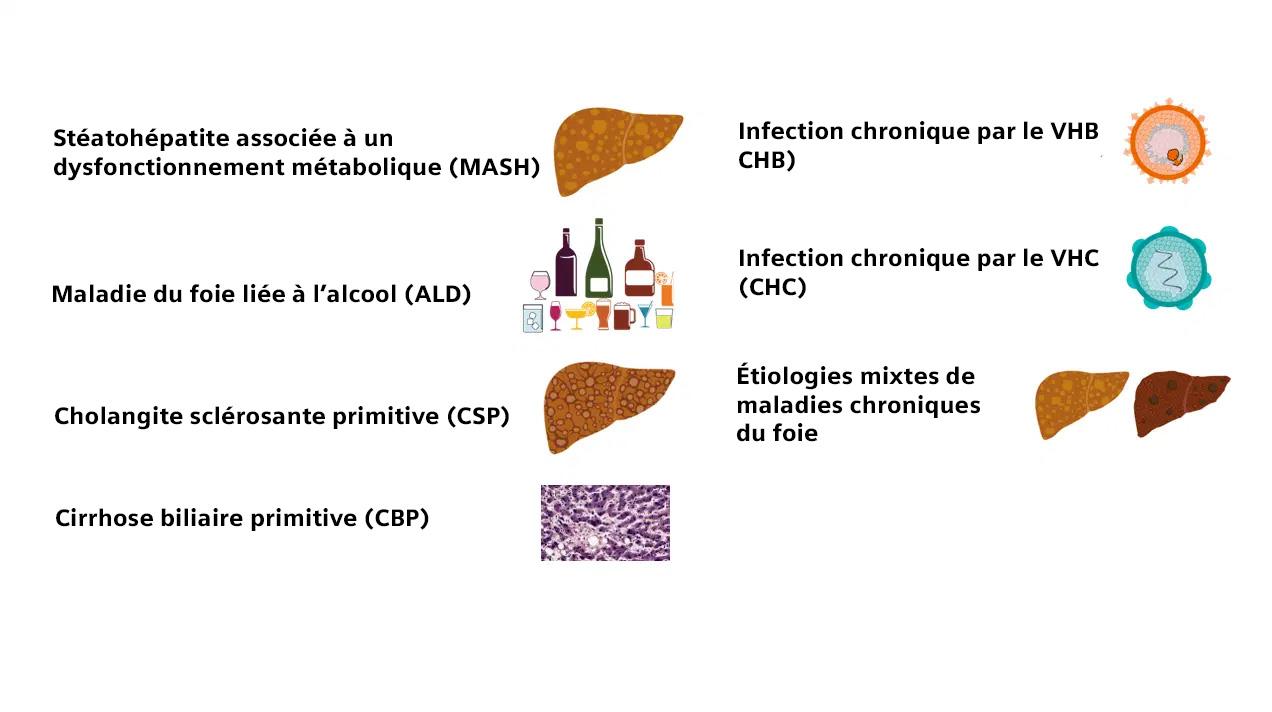
siemens-healthineers_DX_LS_ELF_Mixed-Etiologies_FR.
De nombreuses publications décrivent l’utilité clinique du score ELF dans différentes formes de maladies chroniques du foie. 11-15
  • NAFLD (Non-Alcoholic Fatty Liver Disease) / MASLD (Metabolic dysfunction Associated Steatotic Liver Disease)
  • NASH (Non-Alcoholic SteatoHepatitis) / MASH (Metabolic dysfunction-Associated SteatoHepatitis)
  • Maladie du foie liée à l’alcool (ALD)
  • Cholangite sclérosante primitive (CSP)
  • Cirrhose biliaire primitive (CBP)
  • Infection chronique par le VHB (CHB)
  • Infection chronique par le VHC (CHC)
  • Étiologies mixtes de maladies chroniques du foie

Plusieurs recommandations internationales concernant la (NAFLD) MASLD / (NASH) MASH mentionnent le score ELF.

Le score ELF est intégré dans de nombreuses recommandations cliniques internationales comme marqueur à la fois diagnostique et pronostique dans la MASLD/MASH.

AASLD (American Association for the Study of Liver Diseases)

“An elevated FIB-4 followed by elevated liver stiffness or an increased ELF can be used as a sequential strategy to identify advanced fibrosis.”

Rinella M, et al. Hepatology (Baltimore, Md.) vol. 77,5 (2023): 1797-1835. doi:10.1097/HEP.0000000000000323

AACE (American Association of Clinical Endocrinology)

"Clinicians should consider persons belonging to the 'high-risk' groups who have an indeterminate or high FIB-4 score for further workup with an LSM (transient elastography) or ELF test, as available."

Cusi K, et al. Endocrine Practice 28 (2022) 528-562.

AGA (American Gastroenterological Association)

“We concluded that the ELF Test may be used as a confirmatory prognostic test in patients with lean NAFLD until further data are available.”

Long, M, et al. Gastroenterology. https://doi.org/10.1053/j.gastro.2022.06.023

APASL (Asian Pacific Association for the Study of the Liver)

"More specific fibrosis markers are needed in specialist settings to guide the management of patients. The Enhanced Liver Fibrosis Test has been tested in multiple observational studies and clinical trials with good overall accuracy." 

https://pubmed.ncbi.nlm.nih.gov/33006093/

BSG (British Society of Gastroenterology)

"Patients with intermediate risk should undergo second-line non-invasive testing either by additional tests like ELF test or FibroTest or by measuring liver stiffness.7,8 If advanced fibrosis is ruled out, patients can be treated as low risk and referred back to primary care."

https://www.bsg.org.uk/clinical-articles-list/naflddiagnosis-assessment-and-management/

CLDF (Chronic Liver Disease Foundation)

"To date, the ELF score demonstrates good correlations with progression of fibrosis in a number of chronic liver diseases."

Younossi ZM, et al. Am J Gastro. 2020;00:1–9. https://doi.org/10.14309/ajg.0000000000001054

EACS (European AIDS Clinical Society)

"Whenever imaging tools are not available or feasible, serum biomarkers and scores (such as ELF) are an acceptable alternative for the diagnosis of NAFLD in PLWH."

EACS Guidelines. version 11.0, October 2021.

EASL (European Association for the Study of the Liver)

"Surrogate markers of fibrosis (NFS, FIB-4, ELF Test or FibroTest) should be calculated for every NAFLD patient, in order to rule out significant fibrosis (≥F2)."

EASL–EASD–EASO. J Hepatol. 2016;64:1388–1402.

AFEF (Association Française pour l'Étude du Foie)

“A specialized blood marker (Fibrometer, Fibrotest, ELF) or a measurement of liver stiffness must be performed in second intention if a simple blood marker suggests the presence of an advanced chronic liver disease”

Boursier J, et al. Non-invasive diagnosis and follow-up of non-alcoholic fatty liver disease. Clin Res Hepatol Gastroenterol. 2022 Jan;46(1):101769. doi: 10.1016/j.clinre.2021.101769. Epub 2021 Jul 28. PMID: 34332133

KASL (Korean Association for the Study of the Liver)

"When subjects are classified as intermediate risk by TE, FIB-4, or the NFS, additional tests such as M2BPGi, AsAGP, ELF, SWE, or MRE can be performed."

Kang H, et al. Clinical and Molecular Hepatology 2021;27:363-401
https://doi.org/10.3350/cmh.2021.0178

NICE (The National Institute for Health and Care Excellence)

"Consider using the Enhanced Liver Fibrosis (ELF) Test in people who have been diagnosed with NAFLD to test for advanced fibrosis."

National Guideline Centre; Royal College of Physicians. NICE guideline NG492016. ISBN 978-1-4731-1996-3.

Asociación Española para el Estudio del Hígado (AEEH)

"Patients in the gray zone could benefit from a second non-invasive method such as ELF or Owl-liver, which would allow defining which patients are at risk of advanced fibrosis."

Romero-Gómez M, et al. Gastroenterología y Hepatología. https://doi.org/10.1016/j.gastrohep.2022.04.001