
Testing pivots away from solely symptom-based, clinically-indicated orders toward on-demand testing and predictive insights
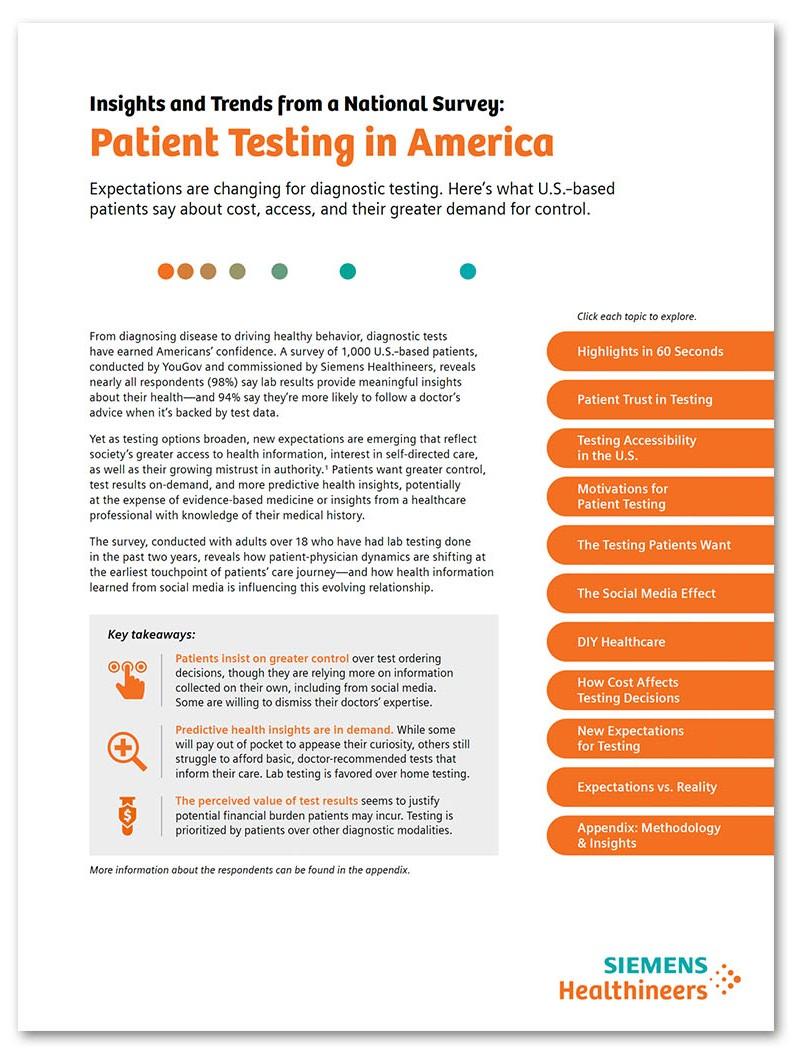
From diagnosing disease to driving healthy behavior, diagnostic tests have earned Americans’ confidence. Yet as testing options broaden, new expectations are emerging that reflect society’s greater access to health information, interest in self-directed care, as well as their growing mistrust in authority.
Patients want greater control, test results on-demand, and more predictive health insights, potentially at the expense of evidence-based medicine or insights from a healthcare professional with knowledge of their medical history.
The survey, conducted by YouGov with 1,000 adults over 18 who have had lab testing done in the past two years, reveals how patient-physician dynamics are shifting at the earliest touchpoint of patients’ care journey—and how health information learned from social media is influencing this evolving relationship.
Friction is ahead as cost pressure and policy headwinds stand between what patients expect and what testing providers may reasonably be able to deliver.

How are patient expectations for medical testing in America changing?
93% of patients expect their doctor to order a test upon request
13% would not trust their doctor’s guidance if they advise against a requested test
17% have requested a lab test they learned about from social media platforms (such as TikTok, Instagram, Facebook, or Reddit)
89% are interested specifically in lab testing that can predict health risks
22% have taken a self-test, motivated by curiosity
27% have pursued blood testing out of curiosity offered by a trusted lab provider independent of a doctor’s recommendation*
*access varies by state
“It’s clear: patients want more control over their health and information about their health earlier. Every patient deserves access to high-quality, innovative diagnostic testing. Sustained investment in laboratory services advances personalized care and ensures that the promise of predictive health insights becomes a reality.”

Survey Insights from Michele Zwickl
Patients want more control and earlier insights: 93% expect their doctor to order a test upon request, and 89% are interested in lab tests that can predict health risks.
In addition to the influence patients expect to have over testing decisions, lab results hold significant value for patients, with 98% of adults agreeing that lab testing provides insightful info about their health and 96% trusting lab tests to provide accurate results. Also, 94% indicate they would be more likely to follow a doctor’s recommendation if it’s supported by lab test results. Patients not only reinforced the value of lab testing but also underscored its utility in motivating them to act on care recommendations.
The second takeaway is a noticeable shift in how test results are obtained, and for what purposes. People are leaning into tests that promise proactive insights about their health now that more of these testing options are available to them—home test kits, tests they can order on their own through a laboratory, or the traditional method through a doctor’s orders. This expands the ways tests are traditionally used: to diagnose, monitor, or predict disease progression.
It’s clear from the data that patients want more control, test results on-demand, and more predictive health insights. Though, it’s potentially at the expense of evidence-based medicine or even insights from a healthcare professional with knowledge of their medical history.
Doctors heavily rely on evidence-based clinical guidelines to inform which tests they order. When they have questions, they turn to medical laboratory professionals who specialize in understanding testing complexities largely obscured from public view.
Yet, 13% of adults outright disagreed when asked if they would trust their doctor’s guidance if they advised against a requested test, and 78% feel they generally understand test results without help from a healthcare provider.
Test results once solely interpreted by healthcare providers, within the context of their patients’ health history, and with support from experienced clinical laboratory professionals when needed, is now shifting to include more patient driven testing, with or without support from intermediary clinicians who may be interpreting information independent of patients’ complete medical history.
Greater access to testing and more informed patients can be ingredients for improved patient care, so long as we don’t overlook or negate the quality controls that have long ensured trustworthy test results.
Patients are motivated by both symptoms and curiosity: 49% have taken a self-test related to an illness or symptom, and 22% have done so out of curiosity. Additionally, 27% have pursued blood testing out of curiosity provided by a trusted laboratory, independent of a doctor’s recommendation.
Cost remains a barrier—29% have unpaid medical bills (with over half including lab fees), and 5% have avoided doctor-recommended bloodwork due to cost. Still, bloodwork is prioritized over other diagnostic modalities, such as imaging.
Patient satisfaction is a top-of-mind metric for healthcare institutions that can affect reimbursement, patient retention, and referrals. The report provides an in-depth look at what’s driving patient influence, action, and expectations.
Providers are navigating increased patient demand for specific tests, sometimes ordering tests simply to satisfy requests, even when not clinically indicated. For example, 37% have requested a lab test based on health-related content they learned through their own research. Further, the influence of social media health information is measurable: 17% of patients have requested a lab test after learning about it on platforms like TikTok, Instagram, Facebook, or Reddit.
This dynamic can challenge evidence-based care when patients are unwilling to trust their healthcare provider’s guidance if they advise against a requested test, as 13% of the respondents suggested. The good news is that patient confidence in their healthcare providers’ expertise remains high: 95% of patients trust their providers to order the most appropriate tests.