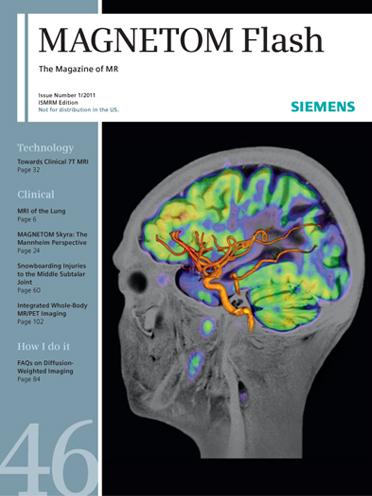
MAGNETOM Flash - April 2011ISMRM Edition

Siemens Healthcare

|01.04.2011
MAGNETOM Flash - April 2011

Technology is fascinating because of its potential to offer solutions to our daily problems. Imaging technologies, however, face challenges from several factors such as speed, availability in clinical routine and even patient comfort. Some of these challenges have meant that in the last century positronemission tomography (PET) was a rarely applied technology in a clinical setting; it proved time-consuming and without the potential to provide important information about anatomy and therefore about, for example, therapy-induced side-effects like thrombosis or pneumonia.

However, by integrating the anatomical information derived from computed tomography (CT) with PET, we acquire much more diagnostic information than would be available by applying these components individually. This combination also overcomes some limitations of a pure PET exam by integrating CT data for PET attenuation correction, which significantly reduces examination time. Today PET/CT is recognized as an imaging technique which can answer clinically relevant questions in multiple scenarios such as lung cancer; it clearly improves patient care and also, indirectly, therapy outcome.

In its first days, magnetic resonance imaging (MRI) was recognized mainly for providing best soft tissue contrast. But it was already known that MRI could do more than providing detailed anatomical information about, for example, biochemical processes through the use of MR spectroscopy. With the inventions such as MR contrast-media, together with the refinement of sequence techniques, MRI is nowadays able to provide both qualitative and quantitative functional information about perfusion and diffusion, as well as motion, such as cardiac wall motion and ejection volume.

Further developments in therapy have, however, triggered new questions from clinicians. Multimodality MRI already plays an important role in understanding disease biology in daily routine. But to provide further, deeper insight into metabolism such as glucose consumption or amino acid synthesis and several functional aspects of tissue like oxygenation or receptor expression, PET is still the imaging modality of choice because of its intrinsic high sensitivity to the probes used within picomolar range.

Of course, some information derived from PET and MRI will be interdependent, ranging from complimentary to contradictory. Thanks to Biograph mMR, we can now combine MRI and PET into one easy-to-handle system and obtain understanding of aspects of the biology of diseases at a single point in time.


Page

Category

Title

Application

Author 

6

Clinical Cardiovascular MRI

Cardiovascular Magnetic Resonance – Update 2010 A Selection of Interesting new Data


Florian von Knobelsdorff-Brenkenhoff, M.D.; Jeanette Schulz-Menger, M.D.
Experimental and Clinical Research Center, Medical University Berlin, Charité Campus Buch and HELIOS Klinikum Berlin Buch, Dept. of Cardiology and Nephrology, Berlin, Germany

20

Clinical
How-I-do-it

SCMR recommended CMR protocols and CMR Users Guide


24

Clinical
How-I-do-it

Low-Dose Contrast-Enhanced MR Angiography


Roya Saleh, M.D.; Paul Finn, M.D.; Yutaka Natsuaki, Ph.D.; Gerhard Laub, Ph.D.
Department of Radiology, University of California at Los Angeles, CA, USA Siemens Healthcare, West Coast Team, MR R&D, Los Angeles, CA, USA

36

Clinical
Cardiovascular MRI

Case Report: Cardiac Imaging with MAGNETOM ESSENZA Cardiac MRI of Anteroapical Infarction in Patient with Left Ventrical Aneurysm with Apical Thrombus / Tako-Tsubo like Syndrome


G. Hadjidekov; G. Tonev
MC ”Pro-Vita”, Sofia, Bulgaria

41

Clinical
Cardiovascular MRI

Assessment and Classification of Peripheral Vascular Anomalies by Time- Resolved MRA using TWIST


Ulrich Kramer, Ulrike Ernemann, Stephan Miller
Diagnostic and Interventional Radiology, University Hospital Tübingen, Germany Diagnostic and Interventional Neuroradiology, University Hospital Tübingen, Germany

45

Clinical
Cardiovascular MRI

Cardiovascular Acronyms


46

Clinical
Cardiovascular MRI

4D Flow MR Imaging


Alex Barker; Jelena Bock; Ramona Lorenz; Michael Markl
Department of Radiology, Medical Physics, University Hospital Freiburg, Germany

53

Clinical
Cardiovascular MRI

Case Report: Combined Assessment of Haemodynamics and Vessel Architecture in a case of Brain AVM


Jens Fiehler, M.D.
Department of Diagnostic and Interventional Neuroradiology, University Medical Center Hamburg-Eppendorf (UKE), Hamburg, Germany

56

Clinical
Cardiovascular MRI

Perfusion Imaging and Stroke


Pavlina Polaskova, M.D.; W. Taylor Kimberly, M.D., Ph.D.; A. Gregory Sorensen, M.D., Ona Wu, Ph.D.
Athinoula A. Martinos Center for Biomedical Imaging, Department of Radiology, Massachusetts General Hospital, Charlestown, MA, USA Massachusetts General Hospital Neuroscience Intensive Care Unit, Harvard Medical School, Charlestown, MA, USA

60

Clinical
Abdomen / Pelvis

Functional Prostate MR Including Dynamic Contrast-Enhanced T1-Weighted Imaging at 1.5 Tesla Without Endorectal Coil. First Clinical Experiences with a Study Protocol at Multi-Imagem, Brazil


Leonardo Kayat Bittencourt, M.D.; Thomas Doring, MSc; Marcio Bernardes, RT; Emerson Gasparetto, M.D., Ph.D.; Romeu Cortês Domingues, M.D.
CDPI Clínica de Diagnóstico Por Imagem, Multi-Imagem, UFRJ - Federal University of Rio de Janeiro, Rio de Janeiro, Brazil

International (English): +49 69 797 6602
You can call us Monday through Friday

8 am to 5 pm CET