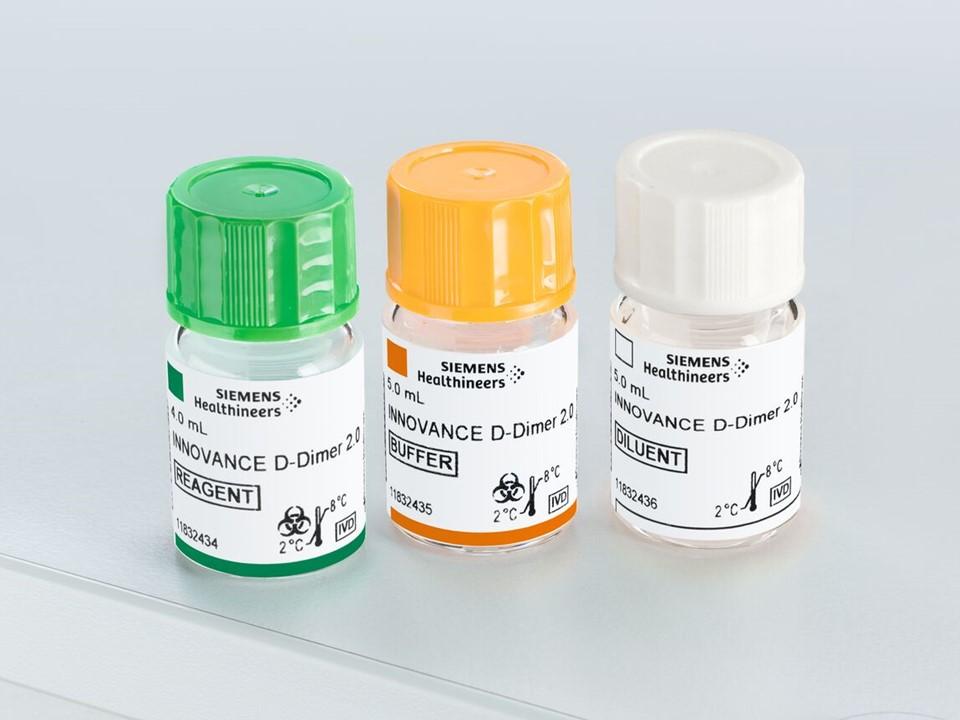
INNOVANCE D-Dimer 2.0 assayDesigned for confidence in DVT/PE assessment
INNOVANCE D-Dimer 2.0 assay is intended for DVT/PE exclusion in outpatients with suspected DVT/PE in conjunction with clinical pretest probability assessment. In addition, it is intended as an aid in the diagnosis and monitoring of DIC and other hypercoagulable states.1
Benefits
Confidence in D-dimer testing goes beyond the result itself. The assay combines robust analytical performance and clinical validation with efficient laboratory workflows to support confident DVT/PE exclusion in routine practice. Designed for today's laboratories, it helps deliver consistent results, streamline operations, and maintain continuity across clinical pathways.

INNOVANCE D-Dimer 2.0 assay provides a dependable analytical foundation for routine practice, helping laboratories deliver consistent results across sites, shifts, and challenging samples.
- Deliver consistent analytical performance across laboratories, analyzer systems, reagent lots, and routine testing conditions.
- Support timely reporting of challenging samples through a broad measuring range, automated redilution, and low susceptibility to common interferences.
- Monitor performance where clinical decisions are made with quality controls positioned around the validated DVT/PE decision threshold.
- Support confident assessment of low D-dimer concentrations with analytical sensitivity designed for measurements near the clinical decision threshold.

Prospective clinical validation and a rigorously established decision threshold provide an evidence-based foundation for confident DVT/PE exclusion in routine practice.
- Support evidence-based DVT/PE exclusion with multicenter clinical validation in more than 2,500 consecutive outpatients.
- Apply a clinically validated decision threshold established according to CLSI H59 recommendations.
- Support multiple clinical applications with evidence for DVT/PE exclusion and for DIC evaluation where indicated.1
- Promote consistent interpretation through alignment with international D-dimer standardization efforts.

INNOVANCE D-Dimer 2.0 assay is designed to simplify daily operation through ready-to-use components, automated workflow steps, and continuous availability.
- Deliver rapid turnaround with fast testing times.
- Reduce hands-on effort using ready-to-use liquid reagents and controls.
- Maintain continuous laboratory operation through long lot and onboard stability and automated workflow steps.
- Keep results flowing with automated redilution and dependable reporting across the measuring range.

INNOVANCE D-Dimer 2.0 assay helps laboratories use resources more efficiently through optimized kit design, simplified handling, and reduced waste.
- Reduce laboratory waste through optimized packaging and low solid and liquid waste generation.
- Get more value from every kit with balanced reagent utilization and ready-to-use reagents and controls.
- Simplify logistics and handling through an integrated kit configuration designed for efficient routine laboratory operation.
- Extend resource efficiency beyond the laboratory by supporting DVT/PE exclusion that can help avoid unnecessary diagnostic work-up and direct hospital resources where they are needed.

INNOVANCE D-Dimer 2.0 assay supports a seamless transition through demonstrated comparability, continuity of clinical practice, and familiar laboratory workflows.
- Transition with confidence backed by extensive analytical verification and practice-oriented validation.
- Preserve established clinical pathways through demonstrated agreement with defined D-dimer assays and continuity at the clinical decision threshold.
- Maintain familiar laboratory workflows with a similar assay structure compared to INNOVANCE D-Dimer assay and straightforward implementation.
- Reduce implementation effort through continuity of clinical interpretation and routine laboratory processes.
INNOVANCE D-Dimer 2.0 assay provides a dependable analytical foundation for routine practice, helping laboratories deliver consistent results across sites, shifts, and challenging samples.
- Deliver consistent analytical performance across laboratories, analyzer systems, reagent lots, and routine testing conditions.
- Support timely reporting of challenging samples through a broad measuring range, automated redilution, and low susceptibility to common interferences.
- Monitor performance where clinical decisions are made with quality controls positioned around the validated DVT/PE decision threshold.
- Support confident assessment of low D-dimer concentrations with analytical sensitivity designed for measurements near the clinical decision threshold.
Clinical Use

DVT/PE exclusion
Support the exclusion of deep vein thrombosis (DVT) and pulmonary embolism (PE) in conjunction with a clinical pretest probability assessment model for outpatients suspected of DVT/PE.

Disseminated intravascular coagulation (DIC)1
Support the diagnosis and monitoring of patients at risk of, or with signs of, disseminated intravascular coagulation (DIC) and other hypercoagulable states.1

Population-specific interpretation
Support clinical interpretation with a validated clinical decision threshold and, where available, additional interpretation tools such as age-adjusted cutoff guidance.
Technical Details
Clinical decision threshold
0.5 mg/L FEU (500 ng/mL FEU)
Reference interval (90th percentile)
0.488 mg/L FEU
Negative predictive value (NPV)
99.8% (PE) / 99.6% (DVT)
Diagnostic sensitivity
99.0% (PE) / 97.4% (DVT)
Diagnostic specificity
57.3% (PE) / 48.0% (DVT)
Clinical validation
DVT/PE exclusion study followed to CLSI H59-A
Technical specifications indicated for use on CN-3000/6000 Systems. Assay performance figures may from country to country as well as with the system application of the respective assay. The values listed above are provided as examples only.
Measuring interval
0.19–80 mg/L FEU (automated re-dilution); initial: 0.19–7.5 mg/L FEU
Limit of detection (LoD)
0.0353 mg/L FEU
Limit of quantitation (LoQ)
0.1270 mg/L FEU
Repeatability
≤3.1% CV across three reagent lots
Within-device precision
≤3.9% CV across three reagent lots
Reproducibility
≤5.26% CV across three systems
Interference testing
Evaluated for hemoglobin, bilirubin, lipids, HAMA, rheumatoid factor, six other endogenous substances, and >40 drugs and medications
HAMA
901 ng/mL
Rheumatoid factor
2141 IU/mL
Technical specifications indicated for use on CN-3000/6000 Systems. Assay performance figures may from country to country as well as with the system application of the respective assay. The values listed above are provided as examples only.
Time to first result (at push of the start button)
Approximately 8 minutes when using the normal mode, micro mode, or for STAT samples; 1 minute between consecutive results
STAT samples
7:56 minutes (micro mode)
Sample type
Citrated plasma, fresh or frozen
Re-dilution
Automated
Stability once opened
Reagents and controls: 1 month at 2-8°C
Reagent onboard stability
120 hours with reagent cap; 12 days2 / 100 hours in original vials
Control onboard stability
12 days2 / 24 hours in original vials
Technical specifications indicated for use on CN-3000/6000 Systems. Assay performance figures may from country to country as well as with the system application of the respective assay. The values listed above are provided as examples only.
Reagent kit
Set of three vials of reagent, sample diluent and buffer, and 1 × Calibrator
Reagent formulation
Liquid, ready to use
Reagent capacity
51 tests per vial
Controls
Liquid, ready to use; three control levels available in separate kits
QC levels required
Two control levels
Control frequency
Once per day or per local requirements
Calibrator
Human plasma-based, automatic preparation of calibration curve
Sample diluent
Additionally available separately (optional)
Technical specifications indicated for use on CN-3000/6000 Systems. Assay performance figures may from country to country as well as with the system application of the respective assay. The values listed above are provided as examples only.
Evidence
Confidence backed by rigorous validation
INNOVANCE D-Dimer 2.0 assay underwent an extensive analytical verification and prospective clinical validation program designed to demonstrate reproducible performance under the conditions laboratories encounter every day.
Related Products

Complete your patient assessment
Explore state-of-the-art assays to guide further assessment and therapy adjustment.

We don’t just sell assays. We develop them.
With more than 75 years of experience in hemostasis, our expertise goes far beyond supplying assays. From scientific concept and assay design to optimization and routine laboratory testing, we understand the science behind every step.
Hemostasis testing solutions shaped by experts for experts
Explore a portfolio designed to enhance workflow efficiency and testing confidence.