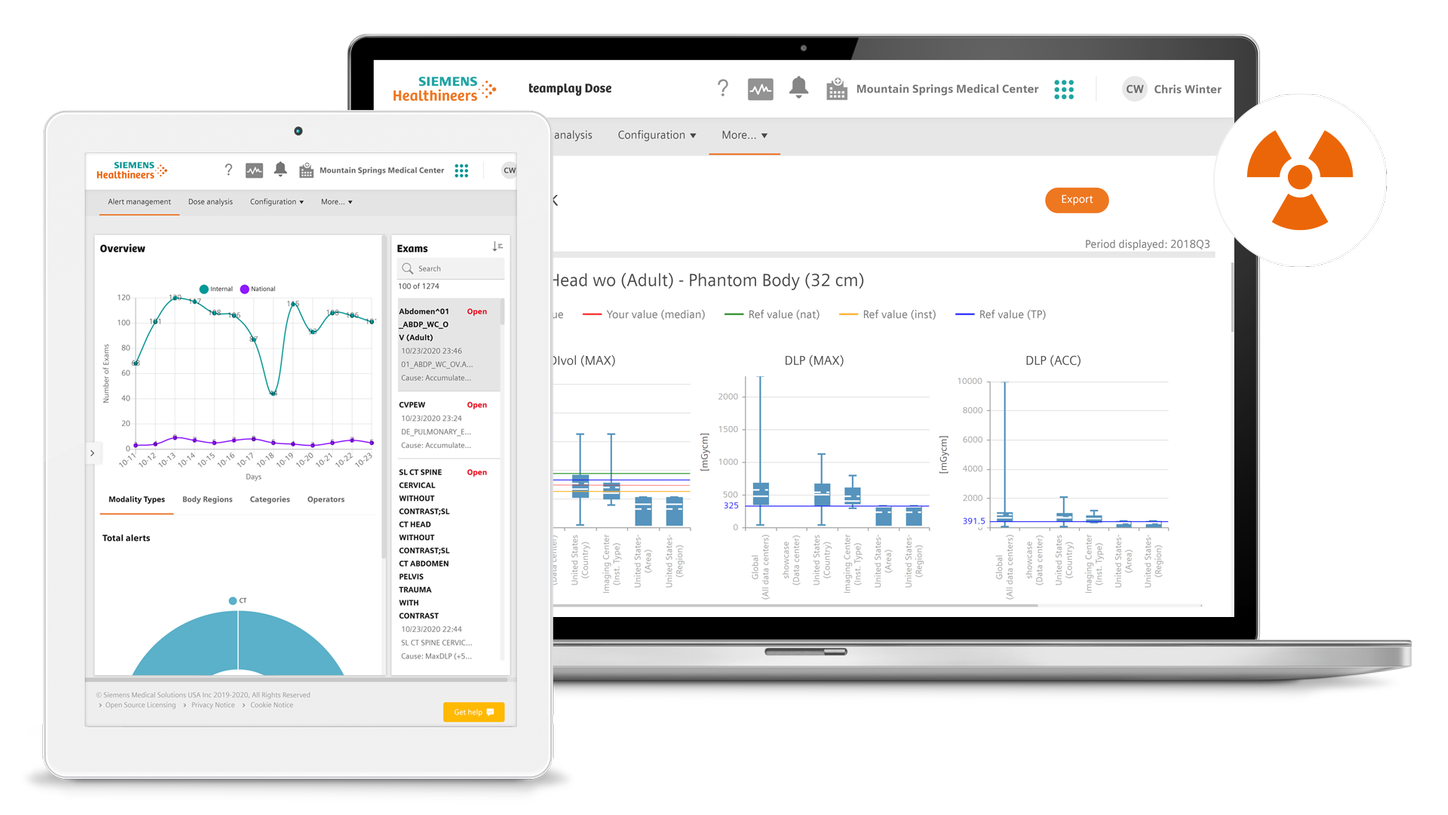
teamplay DoseSimplify your radiation dose management
Following nationally defined reference levels for applied radiation is mandatory. How does your radiology department prove its compliance?
As a healthcare professional you are obligated to keep exposure to ionizing radiation as low as is reasonably achievable (ALARA principle). How do you monitor this?
teamplay Dose1…
- assists you in complying with dose regulations,
- provides evidence and reporting at different aggregation levels and
- helps you to reduce the radiation dose in your imaging procedure.

Our solution for dose monitoring
teamplay Dose is an enterprise-wide radiation dose management solution providing you with easy access to dose data, supporting the quality assurance process for monitoring imaging radiation dosage. teamplay Dose displays data for continuous dose performance evaluation, no matter which modality or vendor is used.
Perform efficient dose data analysis and get an overview of the scan protocols used by type and target region. Monitor the applied radiation over time by displaying the accumulated dose for each individual patient. And compare your outcomes among peers using global benchmarking2 with teamplay Dose.
What does teamplay Dose do for you?
- Analysis: Patient-centric dose monitoring, including information from multiple sources, image headers, DICOM Radiation Dose Structured Report (RDSR), and optical character recognition (OCR) on dose report images
- In-depth insights: Size-specific dose estimate (SSDE) and effective dose calculation using smart algorithms
- Comparison: Benchmark against peers and national and institutional reference levels
- Report: Reporting on dose events and storage for future quality assurance
Currently, there’s an increasing interest in radiation dose monitoring and management because of legal regulations and concerned patients.
As, in general, patient care remains a primary concern, you are obliged to follow legislation and regulations in order to apply the right dose for each patient. An important and fundamental principle is the ALARA (As Low As Reasonably Achievable) principle. It is the basis for keeping the amount of emitted radiation dose as low as possible and for achieving the right balance between applied radiation dose and image quality.
Constant monitoring of the applied radiation dose is key to reach for an optimum in patient care. Radiation dose outliers are triggers to start scrutinizing data. The question arises: Is the patient’s habitus the cause of an elevated radiation exposure, or might a faulty scan protocol be the trigger?
Overall, this means that whether during the selection of the scan protocol, the parameter modification at the scanner, the examination itself or review of applied radiation dose values, transparency is important.
The European Commission published a directive that covers these topics. A directive is one of the legal instruments available to the European institutions for implementing European Union policies. It is a flexible instrument mainly used as a means to harmonize national laws. It requires EU countries to achieve a certain result but leaves them free to choose how to do so.3 It can be distinguished from regulations which are self-executing and do not require any implementing laws in the member states.
The aim of the 2013/59/Euratom directive4 is to define basic safety standards for the exposure of workers and the general public against the dangers of ionizing radiation. Among other things, it contains new stipulations for recording and documenting dose levels that occur during medical procedures, as well as for the use of diagnostic reference values. Because the justification of each individual medical exposure plays a major role in the directive, each administered dose has to be documented and, if necessary, annotated.
When it comes to radiation dose monitoring, the following articles and paragraphs of the directive, out of the Official Journal of the European Union (17.1.2014), are the most important to understand.

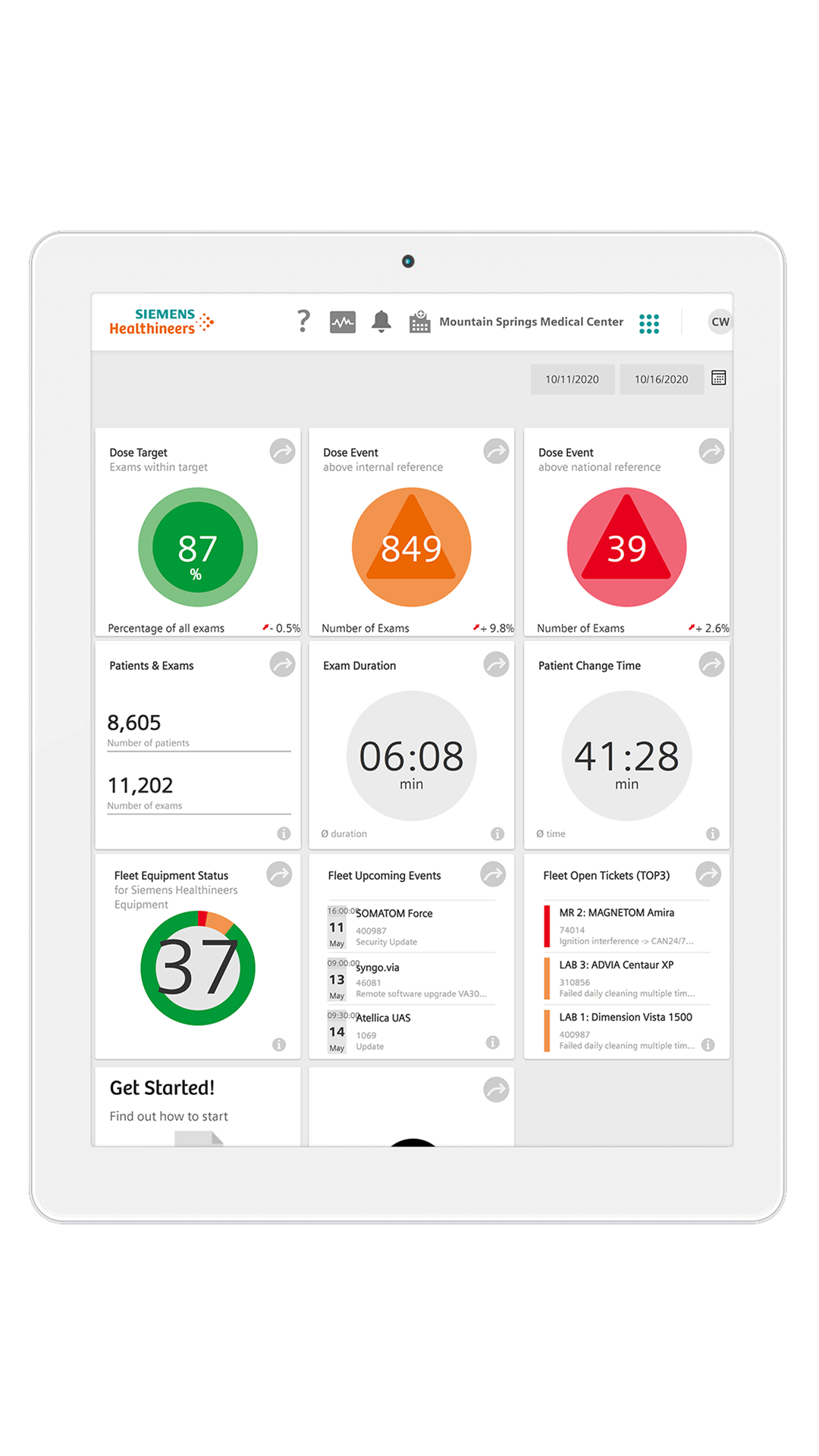
Fig. 1: After logging on to teamplay, the home screen shows clearly all key performance indicators of your institution at one glance, including radiation dose.
Article 56
Art. 56 §2: A regular review and the use of reference values.
teamplay Dose offers an up-to-date, dynamic report in a defined time frame of radiation dose values in your imaging fleet, to regularly review emitted and injected radiation dose. Data from different modalities, such as CT scanners, angiography and mammography equipment for example can be processed and as teamplay is a cloud-based solution you can have access to your data even when you are not close to the imaging device.
teamplay uses the common DICOM standard Dose Reports, DICOM header information and OCR (optical character recognition) for gathering all the information and due to the fact that DICOM is an international technical standard, data from other vendors besides Siemens can be processed as well.

Fig. 2: The dashboard clearly displays that 2.6% of dose events exceeded the national reference level during the selected time frame (see top right).
Article 58 d
The expert in the institution shall be involved as appropriate for consultation and advice on matters relating to medical exposure.
teamplay Dose helps the expert to compare radiation dose levels with national reference level, which automatically updated by Siemens Healthineers in regards to latest regulations.
In addition the expert is able to set own institutional reference level to further work on the ALARA principle.
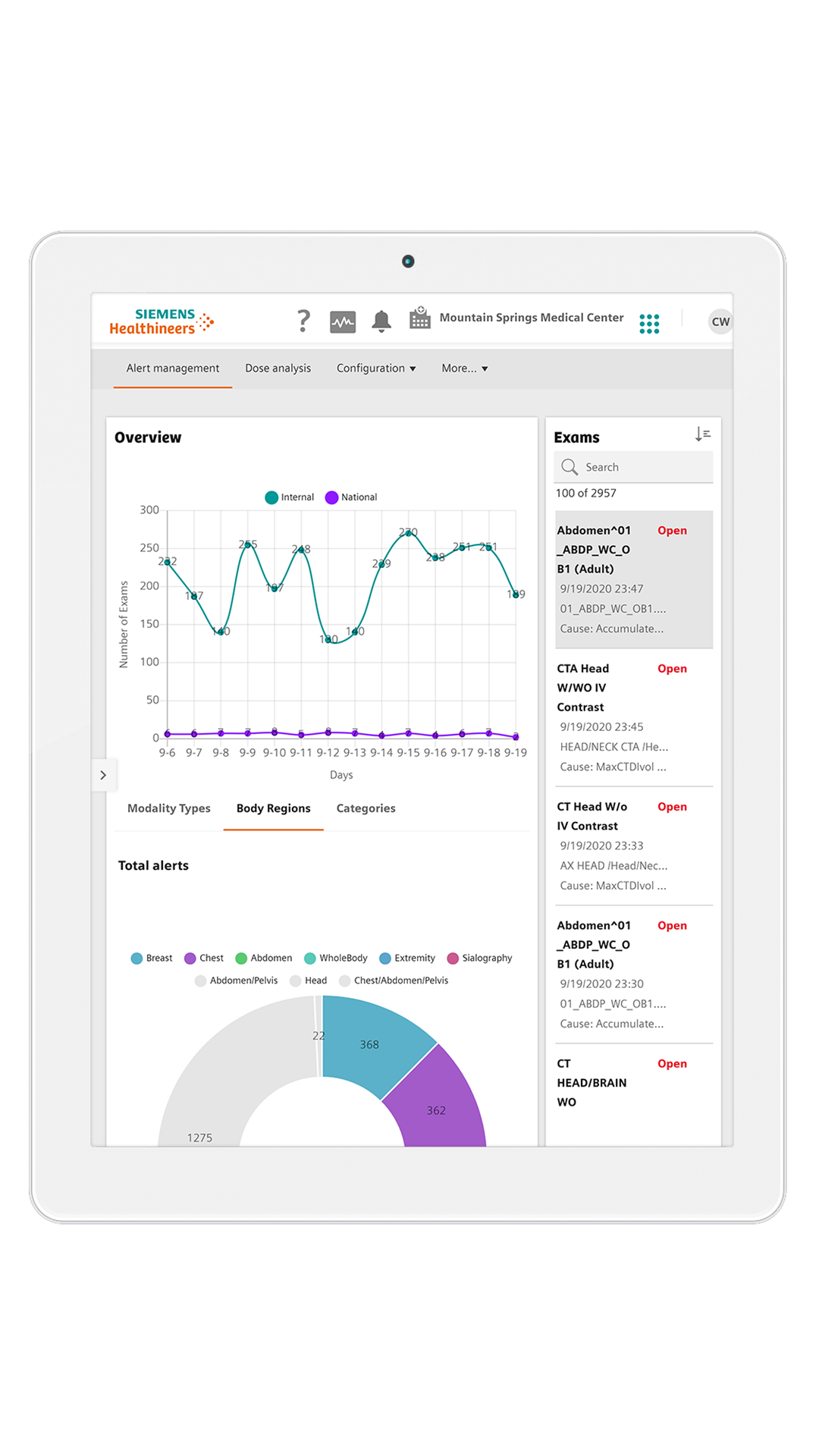
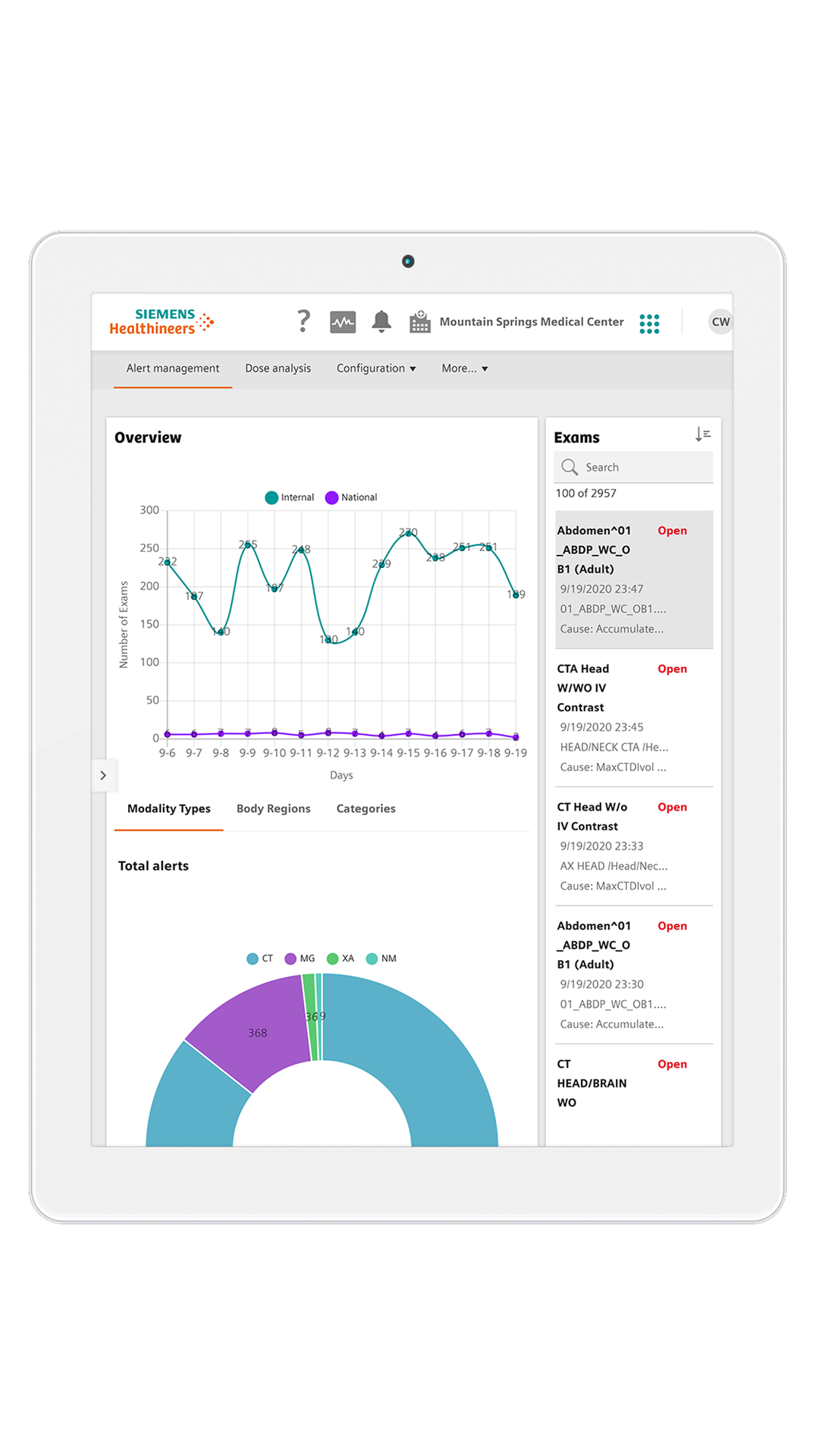
The dashboard on the teamplay home screen indicates how many examinations have exceeded the national reference level or the internal dose target within a defined time period [Fig. 2].
The tile shows as well the trend by comparing the very same time period prior to the selected time period. By clicking on the tile, in-depth information such as scan protocol parameters can be obtained.
Based on the outcome, dedicated measures like adaptation of a scan protocol can be commenced to reduce the number of dose events and so the overall radiation dose performance may improve.
Article 58 f
Art. 58 f: A corrective action is necessary when consistently exceeding reference values.
Member states need to take corrective action, but already on an institutional level. teamplay Dose might drive corrective measures when needed. teamplay Dose clearly lists and displays all dose outliers. From the dashboard, a deep dive, down to the level of a single examination, is possible.
Based on the data teamplay delivers for example the following specific information:
- Operator
- Location
- Modality type
- Body region
- Scan protocol
- Study date and time
- Patient ID
To objectively compare the dose values of the protocols from your facility with those of other facilities, users can utilize teamplay to assign the clinical question or purpose of the examination to their protocols, regardless of their own protocol names and in accordance with the Radlex playbook. The playbook is a terminology and ontology database for radiology developed by the RSNA. Playbook provides a standard system for naming radiology procedures, based on the elements that define an imaging exam such as modality and body part. By providing standard names and codes for radiologic studies, Playbook can facilitate a variety of operational and quality improvements, including workflow optimization, charge master management, radiation dose tracking, enterprise integration and image exchange.


Article 63
Art. 63 c: For all medical exposures the institution needs to implement an appropriate system for the record keeping and analysis of dose events.
With teamplay in place a modern, state of the art system delivers access and keeps track on events with emitted radiation and injected dose.
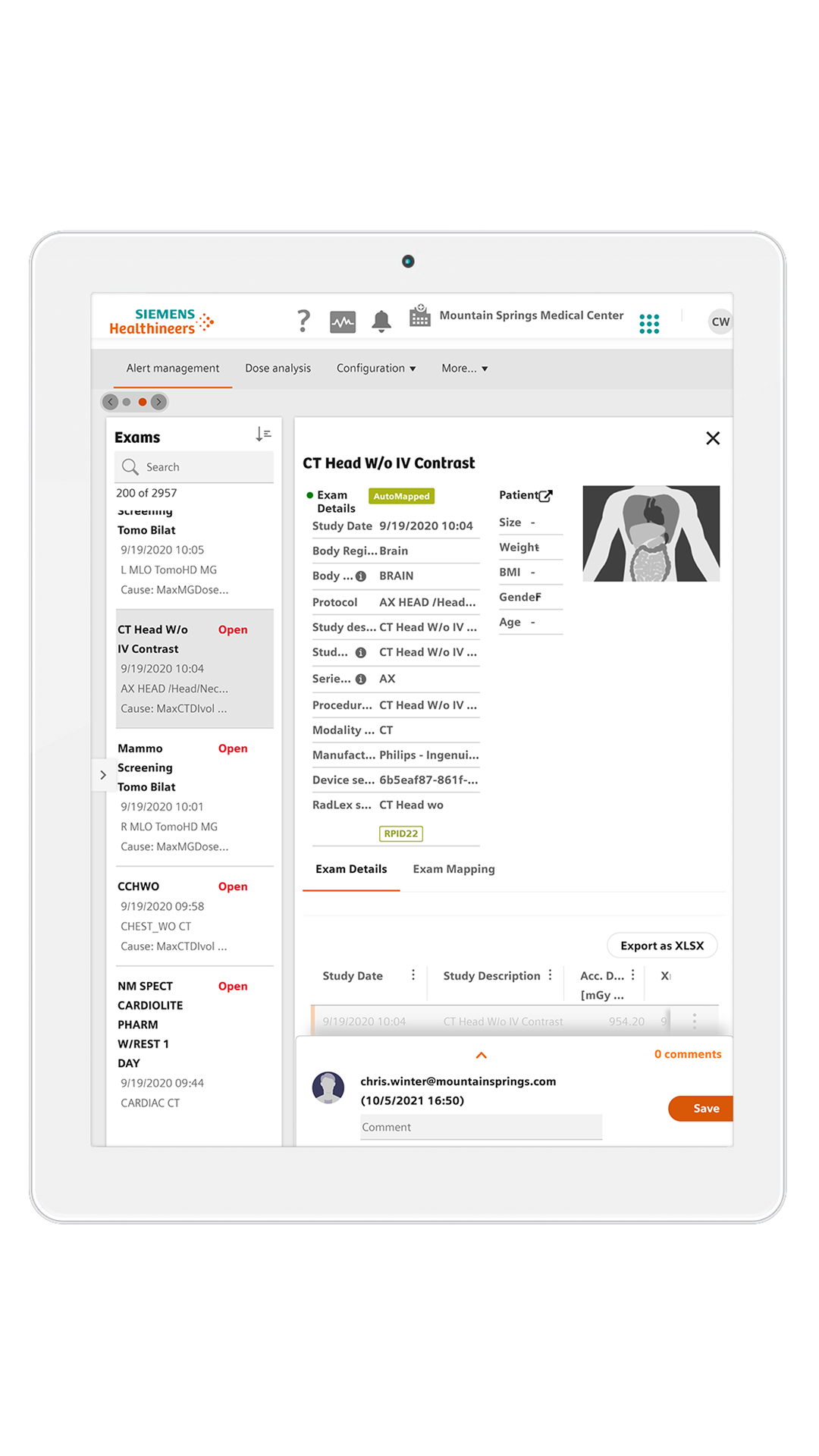
After reviewing and investigating all information on dose outliers, it is possible to annotate them. [Fig. 3] [Fig. 4].
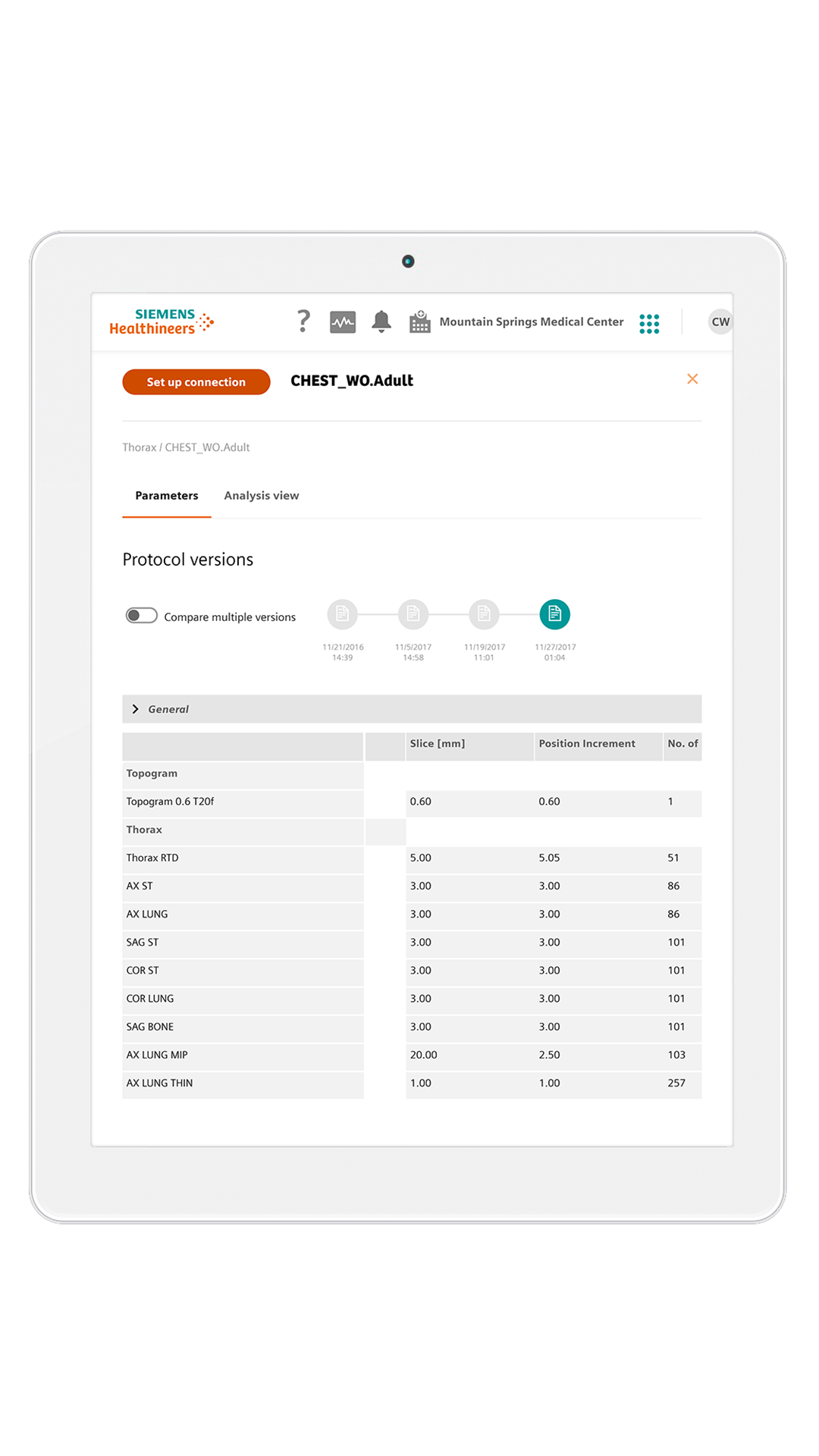
Finding the cause of each dose outlier provides a solid basis for suitable countermeasures [Fig. 5]. If the cause for a dose outlier can be attributed to a faulty CT scan protocol, for example, users can use teamplay Protocols1 [Fig. 6] to immediately access the protocol parameters saved in the CT scanner and initiate measures to optimize the scan protocol. teamplay Protocols can even support with the distribution of standardized scan protocol among the compatible Siemens CT scanners within your modality fleet.
Customer voices
"teamplay helped us to reduce the average dose, received by the patients, by about 10-15% over the last three months."

"With teamplay, we have been able to identify higher dose outliers on our CT protocols and take actions to reduce the overall exposure by 25%."
The statements by Siemens' customers described herein are based on results that were achived in the customer's unique setting. Since there is no "typical" hospital and many variables exist (e.g., hospital size, case mix, level of IT adoption) there can be no guarantee that other customers will achieve the same results.
Did this information help you?
Thank you.
teamplay products are not commercially available in all countries. Due to regulatory reasons their future availability cannot be guaranteed. Please contact your local Siemens Healthineers organization for further details.