- Home
- Medical Imaging
- Magnetic Resonance Imaging
- Clinical Fields
- MR Neuroimaging

MR NeurologyUnderstanding complexity
MRI is the ultimate tool for diagnostic imaging and neuroscience research, providing morphological images with the highest spatial resolution and unmatched soft tissue contrast as well as unique functional information of the central nervous system (CNS).
The advent of new powerful gradient systems has opened opportunities to explore the microstructure of the brain at an unprecedented level. Deep learning reconstruction is fundamentally transforming MR imaging and will allow higher patient throughput without compromising image quality.
At Siemens Healthineers, we firmly believe that combining the latest hardware innovations with software-based features such as deep learning reconstruction will create great momentum in the neuroradiological and neuroscience community. Let's continue to explore the human brain, together.
Highlights
Be at the forefront of the neuroimaging community with our comprehensive solution portfolio for diagnostic imaging and neuroscience research.
MAGNETOM Terra.X
Leverage the full potential of 7T with MAGNETOM Terra.X and its Ultra IQ Technology. This technology brings dynamic pTx, a patient performance model and deep learning based Deep RxE to clinical reality at ultra-high field. And all this is powered by a 135/250 gradient system. Make the difference for patients and discover new insights.
Your benefits:
- Be part of the largest clinical UHF community
- Get unprecedented homogeneity and image quality at 7T with Ultra IQ Technology
- Foster open and collaborative innovation with Open Recon3

Deep Resolve
At the forefront of the revolution in MRI acceleration, Deep Resolve enables game-changing acceleration by combining parallel imaging, SMS and AI-powered image reconstruction1.
Your benefits:
- Drastically reduce scan times and double your in-plane resolution
- Unlock b-values that were previously difficult to obtain in diffusion-weighted imaging
- Open a new dimension in speed with planned Deep Resolve 3D*

MAGNETOM Cima.X
MAGNETOM Cima.X makes the difference for patients and high-end neuroscience research. Leverage our most powerful whole-body MRI system and its Gemini Gradients with a maximum amplitude of 2002 mT/m and a slew rate of 200 T/m/s.
Your benefits:
- Get the most powerful Siemens Heealthineers whole-body MRI ever
- Foster open and collaborative innovation with Open Recon3
- Upgrade your MAGNETOM Prisma to MAGNETOM Cima.X Fit and be part of the community

MAGNETOM Terra.X
Leverage the full potential of 7T with MAGNETOM Terra.X and its Ultra IQ Technology. This technology brings dynamic pTx, a patient performance model and deep learning based Deep RxE to clinical reality at ultra-high field. And all this is powered by a 135/250 gradient system. Make the difference for patients and discover new insights.
Your benefits:
- Be part of the largest clinical UHF community
- Get unprecedented homogeneity and image quality at 7T with Ultra IQ Technology
- Foster open and collaborative innovation with Open Recon3

Deep Resolve
At the forefront of the revolution in MRI acceleration, Deep Resolve enables game-changing acceleration by combining parallel imaging, SMS and AI-powered image reconstruction1.
Your benefits:
- Drastically reduce scan times and double your in-plane resolution
- Unlock b-values that were previously difficult to obtain in diffusion-weighted imaging
- Open a new dimension in speed with planned Deep Resolve 3D*

MAGNETOM Cima.X
MAGNETOM Cima.X makes the difference for patients and high-end neuroscience research. Leverage our most powerful whole-body MRI system and its Gemini Gradients with a maximum amplitude of 2002 mT/m and a slew rate of 200 T/m/s.
Your benefits:
- Get the most powerful Siemens Heealthineers whole-body MRI ever
- Foster open and collaborative innovation with Open Recon3
- Upgrade your MAGNETOM Prisma to MAGNETOM Cima.X Fit and be part of the community

MAGNETOM Terra.X
Leverage the full potential of 7T with MAGNETOM Terra.X and its Ultra IQ Technology. This technology brings dynamic pTx, a patient performance model and deep learning based Deep RxE to clinical reality at ultra-high field. And all this is powered by a 135/250 gradient system. Make the difference for patients and discover new insights.
Your benefits:
- Be part of the largest clinical UHF community
- Get unprecedented homogeneity and image quality at 7T with Ultra IQ Technology
- Foster open and collaborative innovation with Open Recon3


Clinical Applications
Siemens Healthineers exclusive applications
At Siemens Healthineers MR, we are driven to deliver outstanding applications that shift the limits of MRI. The following exclusive features can only be found on our MRI machines and set you apart from competition.

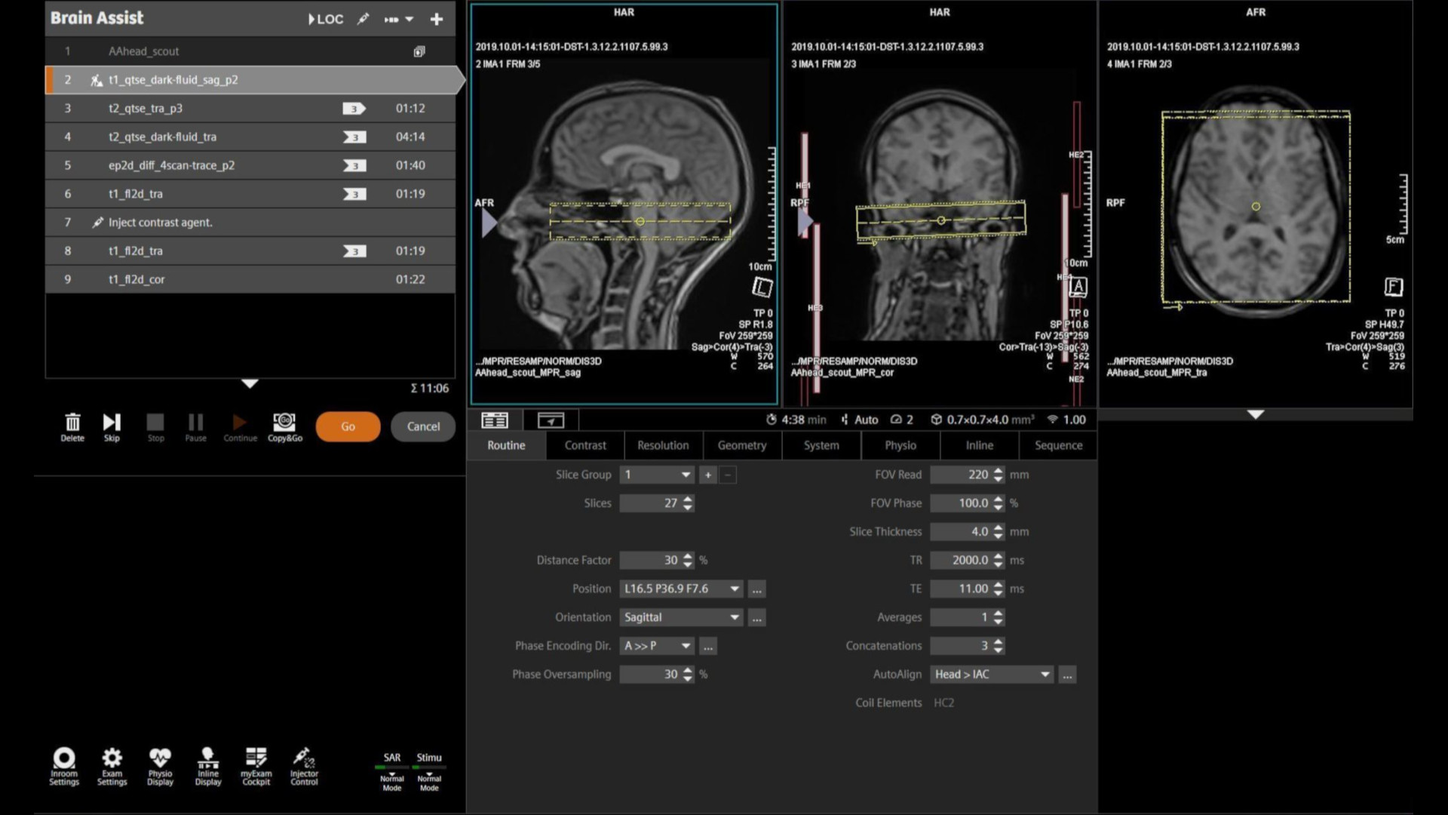
myExam Assist for Brain and Spine
As part of myExam Companion, myExam Assist Brain makes general brain exams easier, more reproducible, and more efficient. myExam Assist Spine optimizes cervical, thoracic, and lumbar spine imaging for a wide range of patients and conditions. AutoAlign automizes slice planning along the whole CNS, automated vertebrae labeling and automatic detection of the spine geometry reduce workflow steps to streamline the exams.
Your benefits:
- Faster and more efficient patient scheduling, consistent results for follow-up exams
- Reduce wasteful workflow steps to be more patient focused
- Strategies and decision points provide clear guidance during the exam

2aaaa2230
Deep Resolve Swift Brain
Based on a multi-shot EPI approach, sophisticated magnetization preparation and deep learning reconstruction, Deep Resolve Swift Brain enables the fastest brain examination ever on our MRI machines. Together with Simultaneous Multi-Slice, net scan times below 2:00 minutes are possible.
Your benefits:
- Fastest standard brain exam on our MRI scanners by multi-shot EPI and deep learning reconstruction
- A new Static Field Correction will further reduce geometric distortions
- Full flexibility: Only acquire contrasts required for your clinical question, save even more scan time

Simultaneous Multi-Slice (SMS) for TSE, BLADE, BLADE Diffusion and RESOLVE
SMS is a paradigm shift in MRI acquisition. This revolutionary technology helps cut neuro DWI scan times by as much as 68%. SMS significantly improves the temporal resolution for BOLD fMRI, for higher sensitivity or specificity. Our exclusive SMS for TSE, RESOLVE, BLADE*, and BLADE Diffusion, accelerates your routine neuro exam beyond the reach of the competition.
Your benefits:
- Substantially reduce scan times with Siemens Healthineers exclusive SMS TSE, RESOLVE, BLADE, and BLADE Diffusion
- The broadest SMS portfolio in the industry can support you in keeping scan slots to a minimum
- Push the limits in brain imaging research with SMS acceleration factors up to 8

Courtesy of Royal Melbourne Hospital (RMH), Melbourne, Australia | 2aaaa2913
BioMatrix Motion Sensor4
Significantly reduced motion artifacts in clinical brain MRI5: The new BioMatrix Motion Sensor is a software-based retrospective motion correction for MPRAGE imaging. By sensing six motion degrees of freedom (three translational, three rotational), patient motion can be mitigated during image reconstruction.
Your benefits:
- Significantly reduced motion artifacts in MPRAGE imaging5
- Retrospective software-based motion correction, no additional hardware required
- Scientifically sound6, clinically proven5

Courtesy of SAHMRI, Adelaide, Australia | 2aaaa2892
Wave-CAIPI SWI
The perfect CAIPIRINHA: Wave-CAIPI SWI allows exploiting coil sensitivity variations in all three dimensions, thereby achieving remarkable parallel imaging acceleration factors. Obtain SWI data of the whole brain in substantially less acquisition time than before, outrun potential motion artifacts and keep patient table times at bay.
Your benefits:
- Higher acceleration factors by optimal usage of three-dimensional coil sensitivity variations
- Whole brain SWI in less than two minutes
- Most beneficial in combination with BioMatrix Head/Neck 64 channel coil with CoilShim for optimal SNR and field homogeneity

Magnetic Resonance Fingerprinting
Magnetic Resonance diagnostics is at the frontier of a paradigm shift. Until now, an MR image has been a mixture of weighted tissue properties, provided by sequential, repetitive data-acquisition with fixed parameters. Diagnostic evaluation has been purely qualitative, and highly dependent on system parameters. Magnetic Resonance Fingerprinting (MRF) makes it possible to glean quantitative information from scans that enable decisions based on digital tissue data, not visual impressions. The target anatomy can be described numerically instead of visually.
Your benefits:
- Be a pioneer in the clinical research space with MRF
- Robust, repeatable and reproducible – across sites, across scanners, in-vivo
- Acquire quantitative multi-parametric data, simultaneously

BioMatrix Head/Neck 64 channel coil with CoilShim
Specially designed to enable highest SNR, large FoV head/neck imaging together with maximal user flexibility and patient comfort. Our Siemens Healthineers exclusive CoilShim improves magnetic field homogeneity in the difficult neck region for optimal image quality and fat suppression.
Your benefits:
- The industry’s highest density Head/Neck coil
- Designed for ease of use and high patient comfort
- Industry-only CoilShim functionality for outstanding homogeneity in challenging situations

myExam Assist for Brain and Spine
As part of myExam Companion, myExam Assist Brain makes general brain exams easier, more reproducible, and more efficient. myExam Assist Spine optimizes cervical, thoracic, and lumbar spine imaging for a wide range of patients and conditions. AutoAlign automizes slice planning along the whole CNS, automated vertebrae labeling and automatic detection of the spine geometry reduce workflow steps to streamline the exams.
Your benefits:
- Faster and more efficient patient scheduling, consistent results for follow-up exams
- Reduce wasteful workflow steps to be more patient focused
- Strategies and decision points provide clear guidance during the exam

2aaaa2230
Deep Resolve Swift Brain
Based on a multi-shot EPI approach, sophisticated magnetization preparation and deep learning reconstruction, Deep Resolve Swift Brain enables the fastest brain examination ever on our MRI machines. Together with Simultaneous Multi-Slice, net scan times below 2:00 minutes are possible.
Your benefits:
- Fastest standard brain exam on our MRI scanners by multi-shot EPI and deep learning reconstruction
- A new Static Field Correction will further reduce geometric distortions
- Full flexibility: Only acquire contrasts required for your clinical question, save even more scan time

Simultaneous Multi-Slice (SMS) for TSE, BLADE, BLADE Diffusion and RESOLVE
SMS is a paradigm shift in MRI acquisition. This revolutionary technology helps cut neuro DWI scan times by as much as 68%. SMS significantly improves the temporal resolution for BOLD fMRI, for higher sensitivity or specificity. Our exclusive SMS for TSE, RESOLVE, BLADE*, and BLADE Diffusion, accelerates your routine neuro exam beyond the reach of the competition.
Your benefits:
- Substantially reduce scan times with Siemens Healthineers exclusive SMS TSE, RESOLVE, BLADE, and BLADE Diffusion
- The broadest SMS portfolio in the industry can support you in keeping scan slots to a minimum
- Push the limits in brain imaging research with SMS acceleration factors up to 8

Courtesy of Royal Melbourne Hospital (RMH), Melbourne, Australia | 2aaaa2913
BioMatrix Motion Sensor4
Significantly reduced motion artifacts in clinical brain MRI5: The new BioMatrix Motion Sensor is a software-based retrospective motion correction for MPRAGE imaging. By sensing six motion degrees of freedom (three translational, three rotational), patient motion can be mitigated during image reconstruction.
Your benefits:
- Significantly reduced motion artifacts in MPRAGE imaging5
- Retrospective software-based motion correction, no additional hardware required
- Scientifically sound6, clinically proven5

Courtesy of SAHMRI, Adelaide, Australia | 2aaaa2892
Wave-CAIPI SWI
The perfect CAIPIRINHA: Wave-CAIPI SWI allows exploiting coil sensitivity variations in all three dimensions, thereby achieving remarkable parallel imaging acceleration factors. Obtain SWI data of the whole brain in substantially less acquisition time than before, outrun potential motion artifacts and keep patient table times at bay.
Your benefits:
- Higher acceleration factors by optimal usage of three-dimensional coil sensitivity variations
- Whole brain SWI in less than two minutes
- Most beneficial in combination with BioMatrix Head/Neck 64 channel coil with CoilShim for optimal SNR and field homogeneity

Magnetic Resonance Fingerprinting
Magnetic Resonance diagnostics is at the frontier of a paradigm shift. Until now, an MR image has been a mixture of weighted tissue properties, provided by sequential, repetitive data-acquisition with fixed parameters. Diagnostic evaluation has been purely qualitative, and highly dependent on system parameters. Magnetic Resonance Fingerprinting (MRF) makes it possible to glean quantitative information from scans that enable decisions based on digital tissue data, not visual impressions. The target anatomy can be described numerically instead of visually.
Your benefits:
- Be a pioneer in the clinical research space with MRF
- Robust, repeatable and reproducible – across sites, across scanners, in-vivo
- Acquire quantitative multi-parametric data, simultaneously

BioMatrix Head/Neck 64 channel coil with CoilShim
Specially designed to enable highest SNR, large FoV head/neck imaging together with maximal user flexibility and patient comfort. Our Siemens Healthineers exclusive CoilShim improves magnetic field homogeneity in the difficult neck region for optimal image quality and fat suppression.
Your benefits:
- The industry’s highest density Head/Neck coil
- Designed for ease of use and high patient comfort
- Industry-only CoilShim functionality for outstanding homogeneity in challenging situations

myExam Assist for Brain and Spine
As part of myExam Companion, myExam Assist Brain makes general brain exams easier, more reproducible, and more efficient. myExam Assist Spine optimizes cervical, thoracic, and lumbar spine imaging for a wide range of patients and conditions. AutoAlign automizes slice planning along the whole CNS, automated vertebrae labeling and automatic detection of the spine geometry reduce workflow steps to streamline the exams.
Your benefits:
- Faster and more efficient patient scheduling, consistent results for follow-up exams
- Reduce wasteful workflow steps to be more patient focused
- Strategies and decision points provide clear guidance during the exam


More neurology applications
Address all relevant clinical questions with our rich portfolio of MR neurology applications.

ZOOMit
ZOOMit – the first TimTX TrueShape application for clinical use – uses dynamic excitation pulses to achieve selective field-of-view (zoomed) imaging. Zoom into your image to appreciate the smallest details, improve diagnostics and expand research possibilities with ZOOMit, powered by TimTX TrueShape.
Your benefits:
- Zoomed imaging for EPI (DWI and BOLD) and SPACE
- Reduced susceptibility artifacts and geometric distortions in challenging anatomies
- Higher temporal resolution through faster imaging

ASL (Arterial Spin Labeling)
ASL is an MR technique using the water in arterial blood as an endogenous contrast agent to evaluate perfusion non-invasively. Pseudo-continuous ASL (PCASL) allows larger coverage with more and thinner slices in a shorter acquisition time, resulting in higher perfusion image quality.
Your benefits:
- 2D and 3D PCASL enable higher in-plane resolution and thinner slices
- Automatic generation of relative CBF and Bolus Arrival Time maps
- M0 maps are available for research purposes

SWI (Susceptibility-Weighted Imaging)
SWI is an MRI contrast which exploits the susceptibility differences between tissues. As a result SWI can detect deoxygenated blood, products of blood decomposition and microscopic iron deposits much better than conventional MR techniques.
Your benefits:
- Improved depiction compared to T2* contrast of susceptibility variations such as hemorrhages and microbleeding
- 3D imaging for complete brain coverage
- The perfect CAIPIRINHA: Wave-CAIPI SWI for maximum acceleration in SWI
HASTE and BLADE diffusion
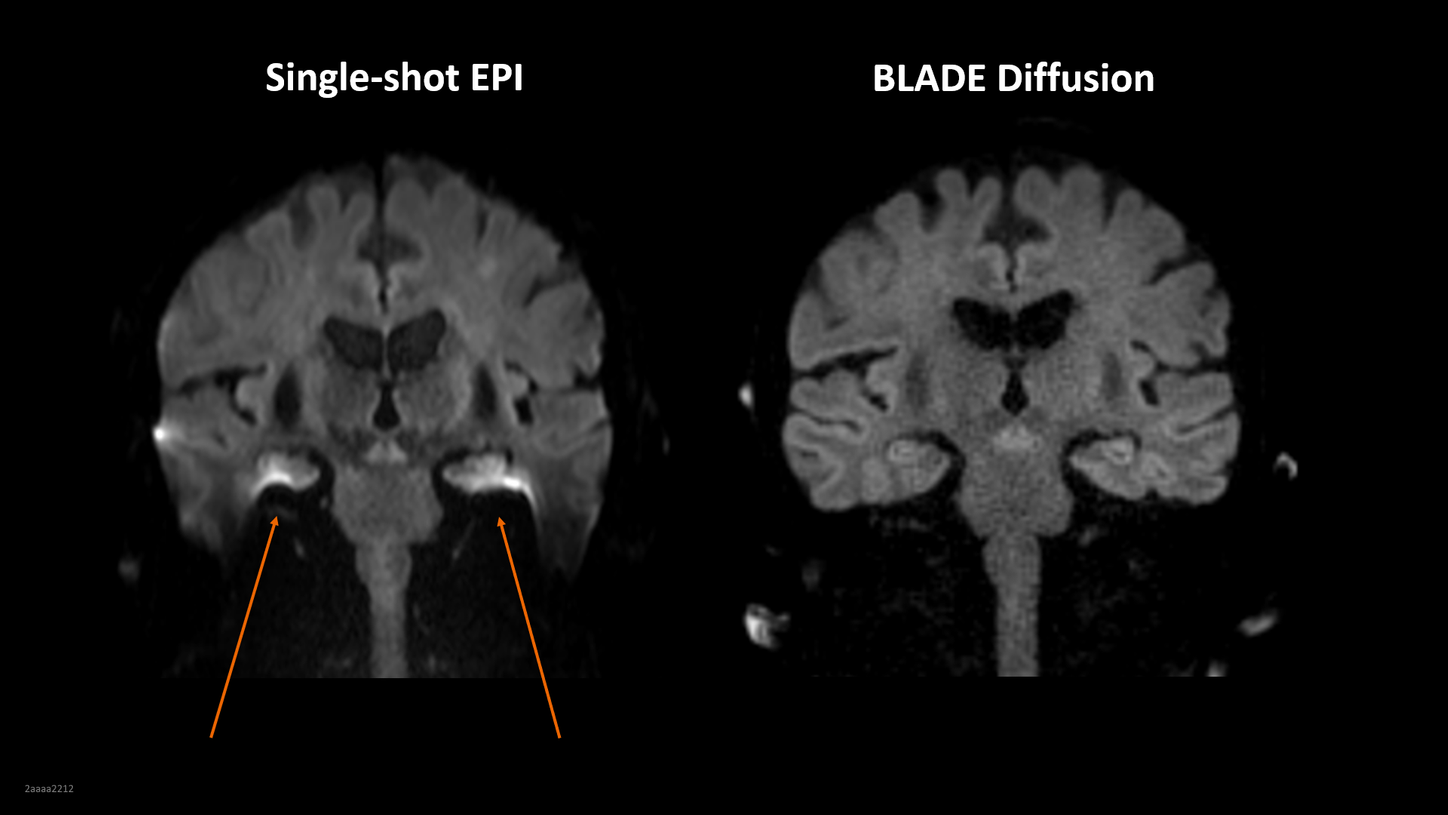
HASTE and BLADE diffusion enable virtually distortion-free diffusion-weighted imaging (DWI) by employing non-EPI acquisition methods. These methods have been found helpful for the detection of cholesteatoma7-9 and bring clarity to DWI in challenging anatomies where susceptibility artifacts cannot be avoided10.
Your benefits:
- Non-EPI-based DWI that is virtually free of geometric distortion
- Siemens Healthineers exclusive: SMS capability for BLADE diffusion to keep scan times at bay
- Superb detection of difficult pathologies such as cholesteatoma7-9 and cerebellopontine angle tumors10
Clinical Focus Topics

Headache
In clinical routine, many MRI scans deal with unspecified headache disorders that account for 50% of all neurology related disorders11. MRI is a tool to clarify if abnormalities in the brain are responsible for the symptoms, but 90% of these scans are usually without pathological findings12. So there is a large amount of routine brain MRI scans that require fast and robust technology to deliver reliable results. We have what it takes to address these requirements:
- An industry leading portfolio of acceleration methods, including Deep Resolve
- Software-based features such as AutoAlign, myExam Companion and BioMatrix Motion Sensor
- Hardware innovations such as Frequalizers, BioMatrix CoilShim and our industry-leading BioMatrix Head/Neck 64 channel coil

Emergencies
Stroke is the second leading cause for death among all diseases, only surpassed by cardiovascular disease11. Time is brain in acute stroke, and while CT is typically the method of choice, MRI is considered equivalent by current guidelines13 and has even been shown to be more effective14. Besides stroke and in particular wake-up strokes15, MRI can play a decisive role in vulnerable groups such as pregnant women and cranial trauma16. We support these use cases with innovations such as
- Deep Resolve, our AI-based1 image reconstruction technique
- Deep Resolve Swift Brain for the fastest brain exam ever
- Wave-CAIPI SWI, the perfect CAIPIRINHA
When stroke strikes, be ahead of your time

Neurodegenerative Diseases
Neurodegenerative Diseases (ND) such as Alzheimer’s Disease (AD), dementia, or Multiple Sclerosis (MS) have seen a significant increase in prevalence over the last decade and are the second leading cause of death among neurology related disease, only surpassed by stroke11. With ageing populations in many developed countries, increasing numbers of ND are expected. MRI plays a major role in diagnosing and monitoring diseases such as MS. Additionally, it is also mandated for therapy monitoring of the newest generation of AD drugs that slow the progress of early stage AD.
- ASNR recommended protocols for AD therapy monitoring can be found on our MAGNETOM World user community.
- AI Rad Companion Brain MR for Morphometry might be potentially helpful in identifying patients with early stage AD
- AI Rad Companion Brain MR for White Matter Hyperintensities automatically determines count, volume, and location of white matter hyperintensities
Clinical Practice
Siemens Healthineers‘ global MRI community MAGNETOM World offers peer-to-peer information, providing first-hand experiences from MAGNETOM users.
Case Studies
With the upcoming of monoclonal antibody drugs that slow the progress of AD, an increased demand for MR monitoring of side effects – so called Amyloid Related Imaging Abnormalities (ARIA) – is expected. The ASNR has published a white paper on how to perform the monitoring scans, and our collaborators from Washington University in St. Louis/MO, USA, have compiled ASNR compliant protocols for various 1.5T and 3T MAGNETOM scanners.
The scientific method behind BioMatrix Motion Sensor is called Scout Accelerated Motion Estimation and Reduction (SAMER). To learn more about the method, an article providing an overview on the technical aspects behind SAMER is available. SAMER has been shown in a clinical study to substantially reduce motion artifacts in clinical brain MRI3 and can make the difference between a diagnostic and a non-diagnostic scan.
While CT is usually the workhorse in Emergency Departments (ED) in the evaluation of acute stroke, MRI is from a guideline perspective equivalent to CT. In a very insightful article, researchers from the University Hospital in Lausanne, Switzerland, describe how they managed to switch their workflow from CT-centered to MRI-centered in the workup of acute stroke.
This special print for the 10th Annual European Stroke Organisation Conference includes articles covering MRI, CT and Advanced Therapies, covering the role of imaging at every stage of the stroke patient pathway.