High-V MRI combines the power of digitalization with a new field strength of 0.55T, resulting in excellent diagnostic quality for the routine and new clinical possibilities.
Siemens Healthineers is bringing the digital revolution to your MRI practice. We are constantly perfecting our acquisition technologies to achieve higher image quality while reducing patient slot times. And now with Deep Resolve, we have introduced deep learning-based reconstruction to further enhance the quality of outcomes. MAGNETOM Free.Max leverages the full potential of the digital power of Siemens Healthineers for the utmost in diagnostic quality.

Simultaneous Multi-Slice TSE is a Siemens Healthineers unique method to speed up the data acquisition in TSE imaging. Save up to 50 % scan time by acquiring multiple slices simultaneously - reduce patient slot times, minimize motion artifacts, maintain patient friendliness.

Deep Resolve Gain is an intelligent algorithm that uses individual quantitative noise maps in the reconstruction process for targeted denoising. It is available for a broad range of sequences and boosts image quality for maximum diagnostic capabilities.

Image-ID: 7aaaa0127

Simultaneous Multi-Slice TSE is a Siemens Healthineers unique method to speed up the data acquisition in TSE imaging. Save up to 50 % scan time by acquiring multiple slices simultaneously - reduce patient slot times, minimize motion artifacts, maintain patient friendliness.

Deep Resolve Gain is an intelligent algorithm that uses individual quantitative noise maps in the reconstruction process for targeted denoising. It is available for a broad range of sequences and boosts image quality for maximum diagnostic capabilities.

Image-ID: 7aaaa0127

Simultaneous Multi-Slice TSE is a Siemens Healthineers unique method to speed up the data acquisition in TSE imaging. Save up to 50 % scan time by acquiring multiple slices simultaneously - reduce patient slot times, minimize motion artifacts, maintain patient friendliness.


Image-ID: 1aaaa3623 | 4aaaa0399
Imaging metal implants has historically been difficult with conventional MRI systems as metal causes artifacts. High-V MRI offers intrinsic physical advantages that result in reduced metal distortions and therewith strongly improved diagnostic capabilities for implant imaging.

Image Courtesy: University Hospital Erlangen, Germany | Image-ID: 4aaaa0419
Pulmonary imaging has been notoriously difficult with conventional MRI as the air-tissue interfaces result in a fast signal decay. These challenges scale with magnetic field strength which makes High-V MRI the perfect opportunity for pulmonary imaging. As a result, High-V MRI provides possibilities to expand the reach of pulmonary MRI.

Image-ID: 1aaaa3439 | 4aaaa0297
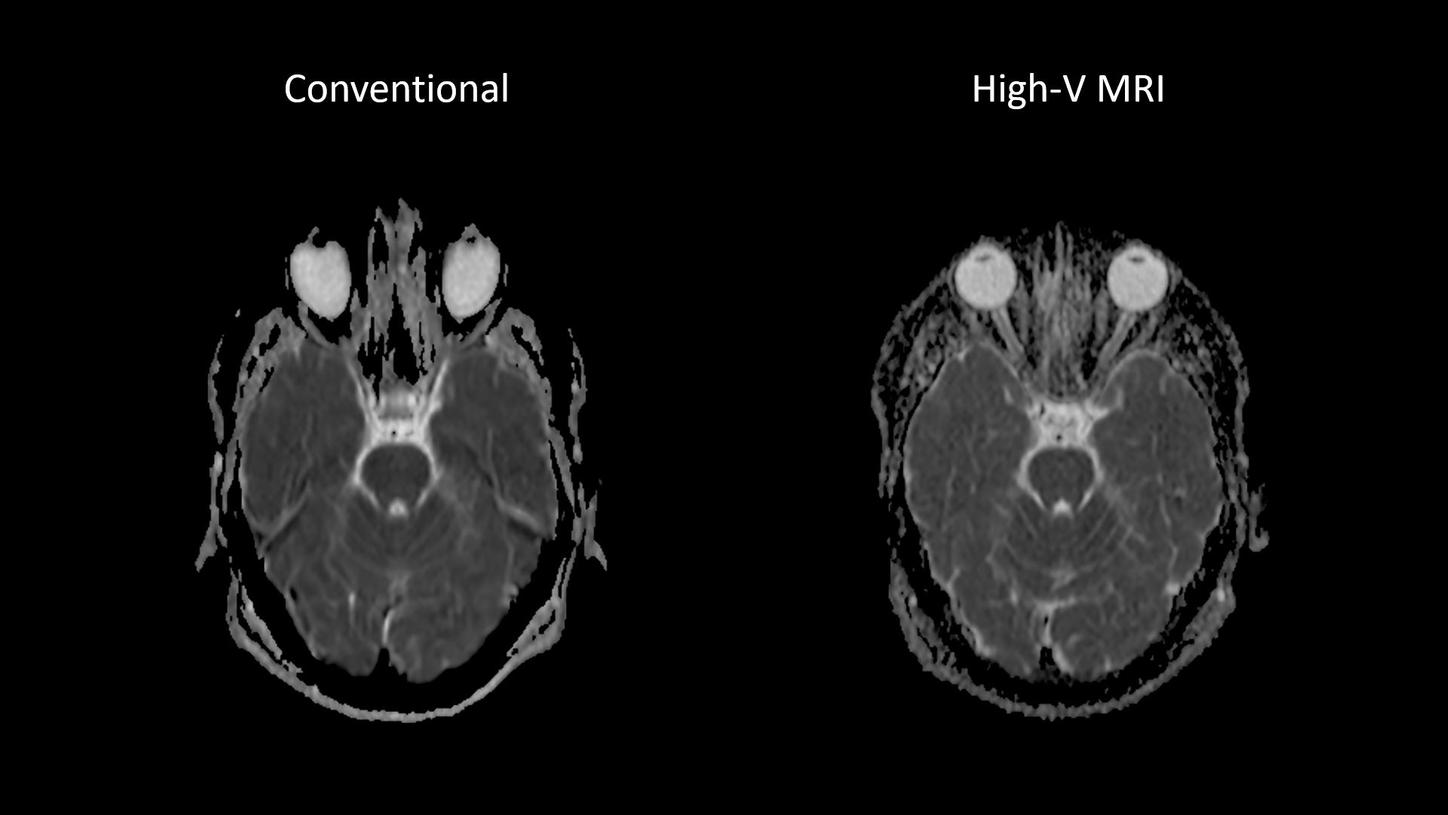
Susceptibility artifacts are a well know phenomena in MRI. One prominent example for such artifacts are at air-tissue interfaces, as they occur at the sinuses and orbits. The unique field strength of High-V MRI offers physical advantages that inherently reduce susceptibility artifacts. This leads to reduced geometric distortions in diffusion imaging which results in improved diagnostic quality.
High-V MRI – Value beyond barriers

Deep Resolve infographic
Get an in-depth overview of Deep Resolve.