- Home
- Vision & perspectives
- Comprehensive Cancer Care Pathway
Addressing the entire cancer care pathway
Creating a world without fear of cancer
Oncology care is becoming increasingly relevant for healthcare organizations and professionals. Overall cancer rates are increasing due to rising life expectancy and growing populations. In 2030, more than 21 million men and women worldwide could develop cancer – 50% more than in 20121.
Belgium is also impacted as we can see in the figures below:
- The disease affects approximately one in three men and one in four women before they reach the age of 75.
- 30.079 Belgians died of cancer in 2020 which represents approximately 82 per day
- The incidence of cancer is greater in Belgium than the EU average
- The most common cancers are:

With recent advancements in treatment options, life expectancy for cancer patients has dramatically improved. Imaging technology that enables earlier detection, highly customized types of radiation therapy, targeted chemo- and immunotherapies have made this possible.
Cancer is a complex disease that requires a multidisciplinary approach to care. At Siemens Healthineers, we offer a comprehensive portfolio of products and services that enable accurate diagnosis, personalized treatment planning, and precise delivery of therapy. Our solutions are designed to meet the needs of each unique patient and help providers optimize their workflows for maximum efficiency.
Our comprehensive cancer care solutions are present during the whole patient journey

1. Screening and Early Detection: Early detection is key to successful cancer treatment. Siemens Healthineers offers a wide range of advanced imaging technologies for cancer screening, including MRI, CT, and PET/CT systems. These imaging technologies provide high-quality images that help physicians identify cancer at its earliest stages, when treatment is most effective. Furthermore, our software solutions offer powerful tools for image analysis and reporting to support accurate and efficient diagnosis.
2. Diagnosis and Therapy Decision: After cancer has been detected, the next step is diagnosis and therapy decision. Siemens Healthineers provides a variety of diagnostic solutions that aid healthcare professionals in identifying the type and severity of cancer. Our technologies include biopsy systems, molecular diagnostics, and pathology solutions. With these tools, healthcare providers can make better informed decisions about the most appropriate treatment for each patient.
3. Treatment Planning and Delivery: Once a treatment plan has been established, Siemens Healthineers offers a range of technologies for treatment planning and delivery. Our radiation therapy solutions include linear accelerators, brachytherapy systems, and treatment planning software. These technologies enable providers to deliver precise doses of radiation to cancerous tissues while minimizing exposure to healthy tissues. We also offer software solutions that enable providers to create personalized treatment plans based on each patient's unique needs.
4. Follow-up and Survivorship: After treatment is complete, follow-up is critical for long-term health and well-being. Siemens Healthineers assists patients throughout their healthcare journey with solutions tailored to their needs. Our solutions include patient monitoring technologies, remote and patient engagement software. These technologies enable patients to stay connected with their healthcare providers and stay informed about their health status.
Our Digital Platforms
Technological advancements in the medical field have led to the development of digital solutions to aid in the management of cancer patients. Noona and Syngo Carbon are two examples of these digital solutions that provide comprehensive assistance for patient monitoring. By using these tools, clinicians can provide personalized treatment based on the individual needs of the patient. While improving his quality of life, it also offers the patient more accurate and offering regular monitoring.
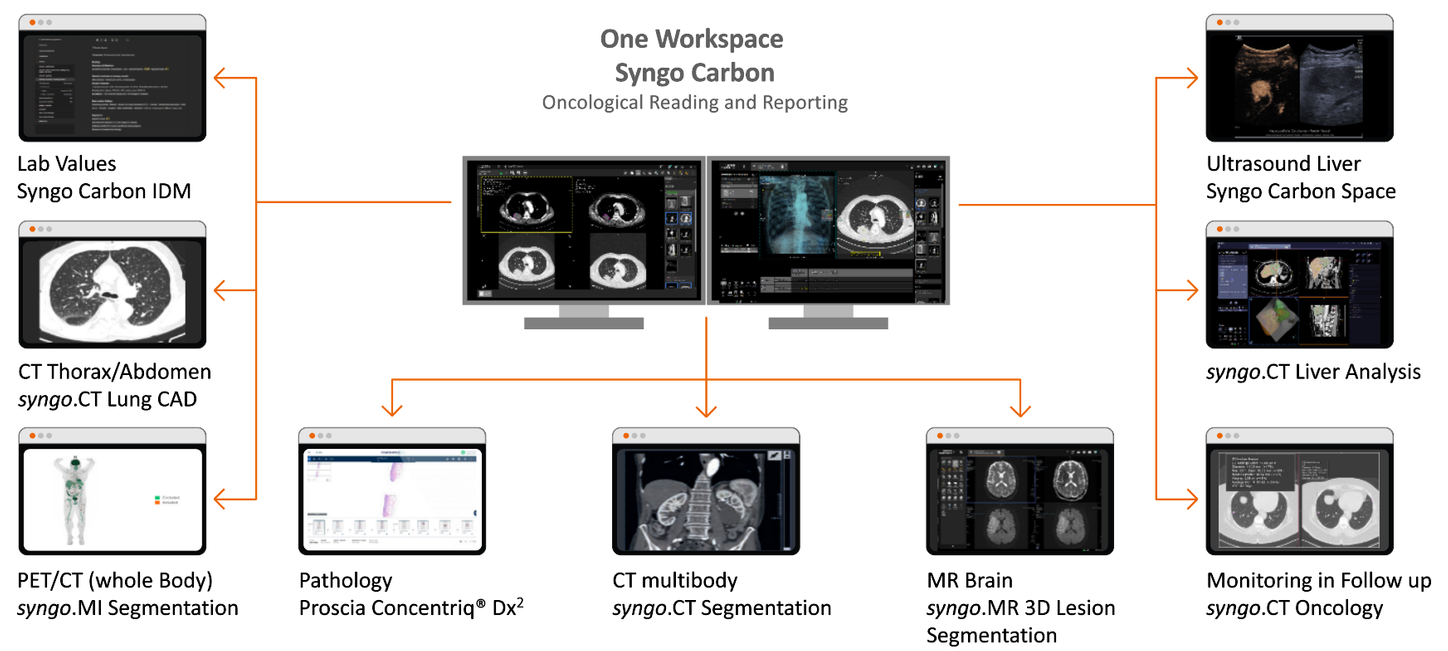
Syngo Carbon is a new enterprise imaging and reporting solution from Siemens Healthineers. Designed to improve patient care, Syngo Carbon opens possibilities in image interpretation, reporting, Artificial Intelligence (AI), and Data Management. Syngo Carbon provides extensive tooling and open data models across modalities in one integrated and user-friendly workspace. Via our partnership with Proscia we provide a solution for Digital Pathology directly into Syngo Carbon.
In the context of comprehensive cancer care, Syngo Carbon's advanced imaging and data management capabilities, as well as its automation and AI features, can play a critical role in enhancing patient outcomes. The software allows healthcare providers to seamlessly access and manage patient data from a range of sources, such as medical images, laboratory results, and electronic health records, enabling more accurate diagnoses and treatment planning. Additionally, Syngo Carbon's visualization tools and AI features can help healthcare providers detect and analyze tumors more effectively, while its automation capabilities can reduce the time and effort required to perform routine tasks. These features, combined with the platform's user-friendly interface and flexibility, make Syngo Carbon an ideal solution for comprehensive cancer care, empowering healthcare providers to deliver personalized and effective care to their patients.
Now we are exploring the power of Syngo Carbon to connect the Pathology Labs, and digitalize the whole imaging chain, from Radiology to Pathology. Providing ONE front end, and interface for a more complete information profile around your patients.
By integrating digital pathology into Syngo Carbon, healthcare providers can enhance their cancer care workflows even more, from diagnosis and treatment planning to monitoring and follow-up care. The platform's advanced imaging and data management capabilities, combined with its pathology-specific tools and integration capabilities, make it an ideal solution for comprehensive cancer care.

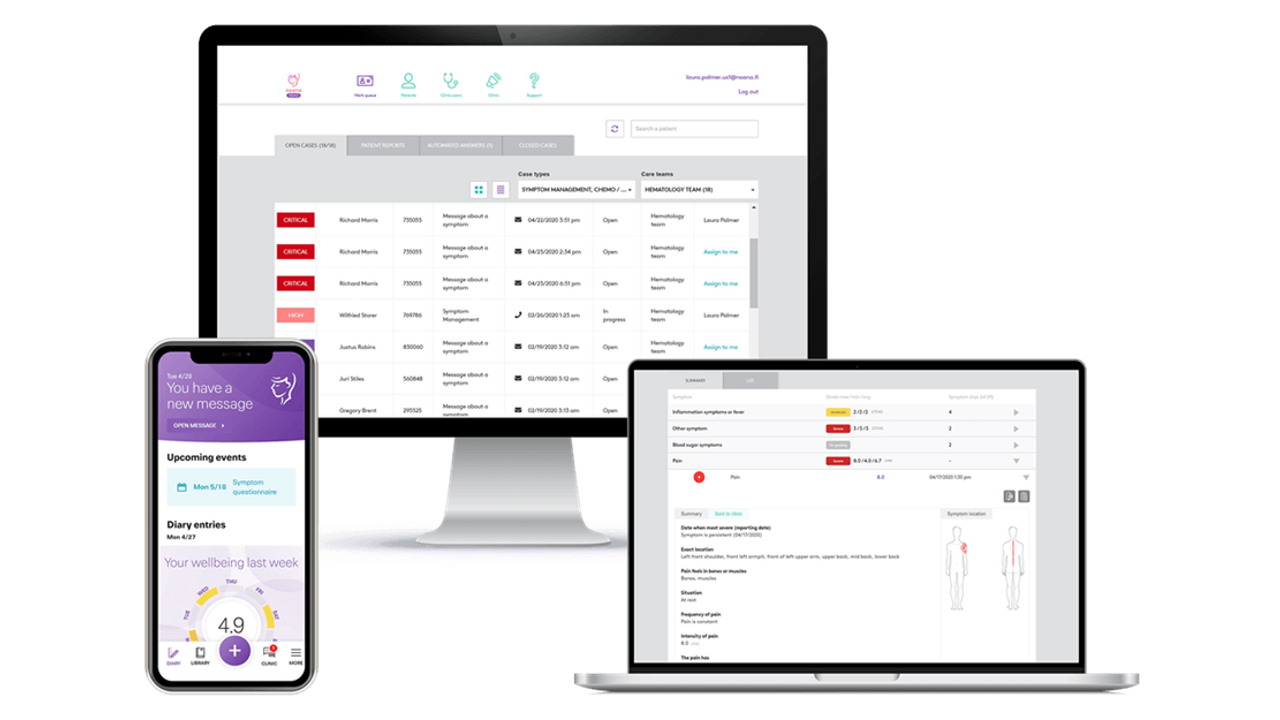
Noona is a mobile service designed for patients with cancer, and it is used during active treatments and post-treatment follow-up. Patients use the service to record their symptoms, respond to symptom questionnaires, and communicate with the clinic. The clinical staff, especially oncology care teams, receive patient contacts directly to their user interface and respond via Noona by way of giving further instructions. Via Noona, the patient receives from care teams instructions for self-care, encouragement to monitor the development of symptoms as well as invitations to tests at the clinic.
Noona is designed for the following areas of cancer therapy:
- Most medical treatments of solid tumor and hematological cancer types.
- Medical oncology medication, including chemotherapy, pharmacotherapy, oral medications, hormone, immunopharmacotherapy, chronic lymphocytic leukemia (CLL) treatment, general hematology.
- Surgical oncology treatments of sarcoma and breast, gynecologic, urological and colorectal cancer.
- General radiation oncology treatment and radiation oncology treatment of pelvic, breast, chest, abdominal, head and neck area, and bone.
- Palliative care for radiation and medical oncology.
- Surveillance and post-treatment monitoring: head and neck, breast cancer, gynecologic cancers, sarcoma, lymphoma, bowel cancer, testicular cancer, lung cancer, urologic, melanoma, and patients diagnosed with cancer at a young age.
Avez-vous jugé cette information utile?
Merci beaucoup
Voulez-vous faire un retour détaillé ?
125 / 125
1. International Agency for Research on Cancer, Globocan 2012: http://globocan.iarc.fr/Pages/burden_sel.aspx
2. https://gco.iarc.fr/today/data/factsheets/populations/56-belgium-fact-sheets.pdf