Our commitment to sustainabilityEnvironmental, Social and Governance

At Siemens Healthineers, we value our stakeholders and recognise the impact our operations may have on patients, customers, investors, employees, and society. Sustainability is embedded in our purpose and our sustainability strategy. We commit to improving healthcare access for everyone, everywhere, preserving our planet’s resources, and developing a diverse and engaged workforce that creates tangible impact internally as well as in the communities we serve. Across all our key initiatives, we actively engage with stakeholders - especially global and regional partners, customers and investors - to amplify our impact and drive long-term value creation. Our sustainability strategy guides our actions globally and locally across the UK and Ireland.

We place particular importance on the wellbeing of our employees and others affected by our activities and on maintaining high Health and Safety standards. Through robust governance, transparent reporting and continuous improvement, we aim to deliver meaningful social value while supporting the transition to a low‑carbon, inclusive healthcare system.

With at least 50% of the world’s population having no access to safe, affordable and timely healthcare services, delivering healthcare is an urgent task. Siemens Healthineers’ technologies and solutions reached 3 billion patient touchpoints worldwide in FY 2025, including over 1.1 billion patient touchpoints in low‑ and middle‑income countries. We are on track to reach our target by FY 2030. This demonstrates tangible progress towards addressing global health inequalities and supporting resilient healthcare systems.

Our commitment is underpinned by our long‑term ambition to significantly expand access to care in underserved regions, while working closely with healthcare providers to deliver efficient, affordable and sustainable diagnostic and therapeutic solutions.

In the UK and Ireland, this global commitment translates into close collaboration with NHS customers to optimise asset utilisation, improve productivity and support high‑quality patient outcomes, while aligning with NHS Long Term Plan and Net Zero objectives.
    Improving Access to Healthcare

    Climate Action, Carbon Reduction and Resource Preservation

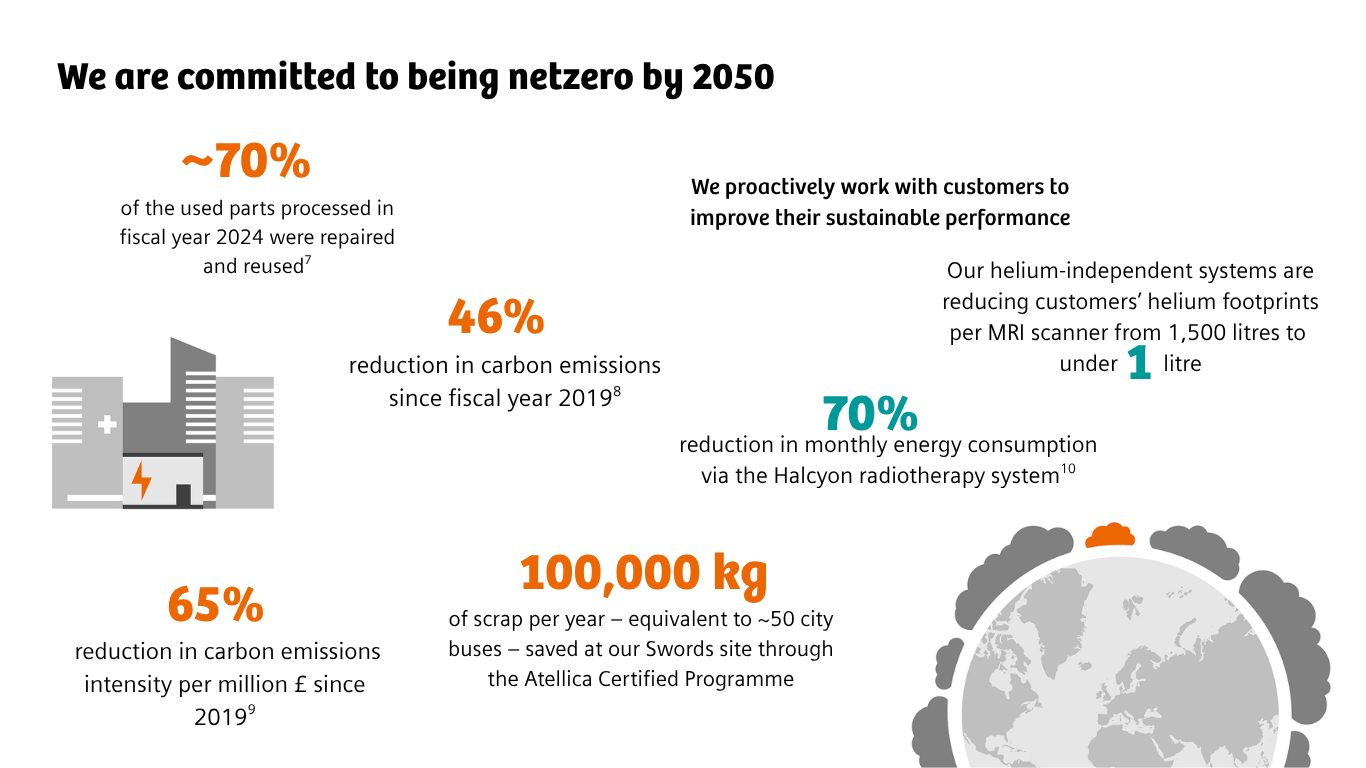
    In response to the urgent call from scientists to decarbonise the global economy, we are taking specific actions and pursuing a long-term climate strategy and net zero targets. Siemens Healthineers has committed to achieving net zero across our entire value chain by 2050. This also includes ambitious near-term 2030 targets. Our net-zero targets have been externally validated by the science-based target initiative (SBTi), confirming they are aligned with the 1.5°C pathway as outlined in the Paris Agreement. Our net zero targets are summarised below:

    • Reduce scope 1 and 2 emissions by 90% by 2030
    • Reduce scope 3 emissions by 28% by 2030
    • Reduce Scope 3 emissions by 90% by 2050

    Globally, we reduced our scope 1 and 2 emissions by 127 kilotonnes of CO2e in FY 2025 compared to our base year in FY 2019. That’s 49% less greenhouse gas emissions (GHG) since 2019. In the same timeframe, our global Scope 3 emissions reduced by 4.5%. This is a clear indicator that we are well on track to reach our target. Aligning with our global science-based targets, Siemens Healthineers in the United Kingdom and Ireland have committed to being net zero by 2050. Further decarbonisation information and how we are going to achieve these targets in GB & Ireland are explained in the Carbon Reduction Plans below.

    Carbon Reduction Plan highlights
    To aid our global science-based target of achieving net zero by 2050 we are actively working to reduce our emissions and carbon footprint in the United Kingdom and Ireland. We have implemented the following initiatives:
    • 100% renewable electricity used across our UK sites.
    • As of 2025, 48% of our fleet are electric vehicles (EV) meaning we are on track to achieve our EV100 target in 2030.
    • Siemens Healthcare Limited (UK) calculated all our relevant Scope 3 GHG emissions categories for our base year and reporting year for the first time, in line with the GHG Protocol. We now have a better understanding of our GHG emissions hotspots.
    • Started engagement with material suppliers on decarbonisation strategies and continued the carbon Web Assessments (CWA), an external tool that enables suppliers to evaluate their emissions and identify reduction opportunities.
    • Achieved a Bronze Ecovadis Medal, placing us among the top 35% of companies assessed.

    Diverse and Engaged Employees

    Our ability to deliver sustainable healthcare solutions depends on a skilled, diverse and engaged workforce. We are committed to providing opportunities for developing our employees and cultivating an inclusive workplace that attracts and engages the best talent.

    Siemens Healthineers has set a target to achieve 30% women representation in senior management roles by FY 2030, with 29.9% achieved as of FY 2025, representing a significant increase since our baseline in 2020 of 15.8%. In the United Kingdom and Ireland, this agenda is actively supported by the Management Team through local champion networks and inclusive leadership initiatives. Furthermore, we are proud to have been recognised by Great Place to Work® as one of the UK’s best Workplaces™ in 2025.

    Embedding Social Value in Practice

    These three pillars are embedded into how Siemens Healthineers operates, bids and delivers for customers:

    • Social Value Model training provided at all levels of the organisation
    • Collaborative engagement during tenders to align solutions to customer‑selected Model Award Criteria (MAC)
    • Agreed KPIs, transparent reporting and continuous improvement throughout contract delivery
    • Clear demonstration of benefits for patients, employees, supply chains and local communities
    • Number of existing policies and practices in place, which directly support the requirements of the Social Value Model.

    Responsible material use and energy efficiency

    Our under‑construction Bicester site is being developed to manufacture MRI systems featuring our DryCool technology, which we have established as a new industry standard. DryCool MRI systems use only 0.7 litres of liquid helium sealed for life, reducing helium inventory in new scanners by up to 99% and improving energy efficiency by 30%.

    Lifetime optimisation

    Our ability to deliver sustainable healthcare solutions depends on a skilled, diverse and engaged workforce. We are committed to providing opportunities for developing our employees and cultivating an inclusive workplace that attracts and engages the best talent.

    Siemens Healthineers has set a target to achieve 30% women representation in senior management roles by FY 2030, with 29.9% achieved as of FY 2025, representing a significant increase since our baseline in 2020 of 15.8%. In the United Kingdom and Ireland, this agenda is actively supported by the Management Team through local champion networks and inclusive leadership initiatives. Furthermore, we are proud to have been recognised by Great Place to Work® as one of the UK’s best Workplaces™ in 2025.

    Waste reduction measures

    Product design, optimisation of processes and innovations in packaging are key levers to reduce waste. Most product packaging materials in shipments are returned to our factory in Germany for reuse or recycling. Packaging used to deliver spare parts is typically reused to return the removed parts to Siemens Healthineers.

    We segregate waste into the various waste streams to recycle wherever possible. We also actively pursuer reduction of waste to landfill by driving sustainable waste management across our operations.

    Sustainable by Design

    Our commitment to resource preservation is embodied in our Sustainable by Design and Ecodesign principles we apply to our product development. We aim to reduce the environmental impact across the product lifecycle through sustainable product design and circular value creation. We integrate requirements along the following four priorities at design stage to promote circular models to reserve resources and lower lifecycle impacts: responsible resource use, energy efficiency, lifetime optimisation and waste reduction.

    Centre for Sustainable Healthcare 

    Siemens Healthineers is partnered with the Centre for Sustainable Healthcare.  

    The partnership reflects a shared commitment to decarbonisation, innovation and building a more sustainable healthcare system. 

    You can find out more about what the collaboration can achieve in delivering sustainable healthcare through the CSH website.  


    Related Informaiton