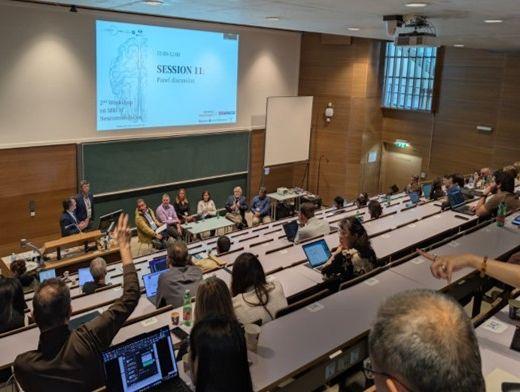
From 7-9th April 2026, the Medical University of Vienna, Austria became a focal point for the latest innovations in magnetic resonance imaging (MRI) and brain function research, with a particular focus on the role of MRI in brain stimulation.
As part of the 2nd Workshop on MRI of Neuromodulation 2026, Siemens Healthineers supported an international workshop bringing together leading experts from Europe, the United States, Hong Kong and China. The community workshop provided a valuable platform for exchanging insights on emerging scientific developments in neuromodulation and advanced MRI.
The program showcased the latest scientific findings from leading experts and included keynote lectures by Professor Hartwig Siebner from Copenhagen and Professor Helen Mayberg from New York. Discussions centered on how collaboration between academia and industry can accelerate promising research concepts towards future clinical applications.
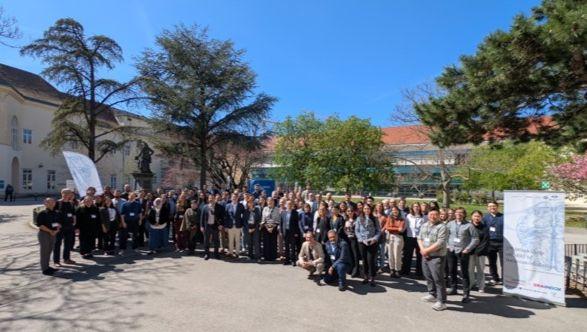
Why Scientific Exchange Matters for Siemens Healthineers
For Siemens Healthineers, the workshop provided an important opportunity to engage directly with the scientific community and gain deeper insights into emerging research needs in this rapidly evolving field. "Open exchange between research, healthcare and industry is essential to drive innovation forward" said Dr. Saba Shirvani, Research Collaboration Manager at Siemens Healthineers. "Workshops like this help us understand how new technologies can be integrated into research environments and what our partners need from us." Saba Shirvani contributed to discussions on the integration of magnetic and electrical stimulation, into 3 Tesla and 7 Tesla MRI environments. The workshop was also supported by Siemens Healthineers global magnetic resonance research and collaboration network through the participation of Tim Viebahn, whose presence further strengthened the dialogue between science and technology.
Spotlight on the "Burrito Approach"
One particularly memorable concept presented during the workshop was the "Burrito approach" introduced by Dr. Martin Tik from the Medical University of Vienna. This setup uses a flexible body receive coil array wrapped around the head to enable whole-brain MRI coverage while allowing concurrent transcranial magnetic stimulation. A promising application currently being explored by Dr. Tik’s research group is the optimization of treatment parameters for depression, including target and dose selection.
Collaboration as a Driver of Innovation
Over recent years, neuromodulation techniques have become increasingly important for studying how complex brain networks interact and influence human behavior. Understanding these networks remains one of the major challenges in neuroscience. The workshop highlighted the importance of close collaboration between academic innovators, clinical researchers and industry partners in shaping the next generation of integrated MRI and neuromodulation technologies.
Siemens Healthineers would like to thank all hosts and organizers, in particular Dr. Martin Tik and Dr. Lena Nohava from the Medical University of Vienna, for this valuable opportunity for scientific exchange.
Will the Burrito approach continue to develop in Vienna? Stay tuned.
Background Information
Neuromodulation refers to technologies used to influence neural activity through magnetic, electrical or ultrasound-based stimulation. Non-invasive approaches are becoming increasingly important tools in neuroscience research.
Transcranial magnetic stimulation (TMS) is a non-invasive technique that uses magnetic fields to precisely modulate brain activity, enabling scientists to influence how specific brain region’s function.
Stronger magnetic fields increase the signal-to-noise ratio and improve spatial resolution, enabling highly detailed visualization of the brain structure, which is a key advantage in neuroimaging research.