


Key Findings
Ultrafast and Free-Breathing Capability
The Turbo Flash mode eliminated the need for breath-holding, significantly enhancing patient comfort and scan feasibility, particularly for patients with compromised respiratory function. The dose-saving potential was especially advantageous for follow-up examinations and pediatric patients.
Functional Lung Perfusion Analysis
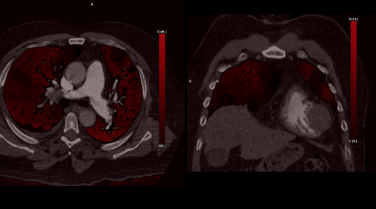
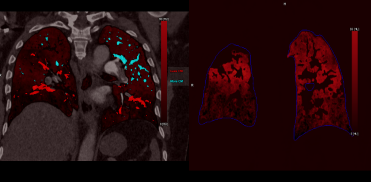
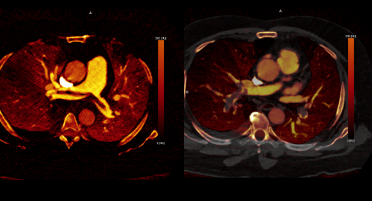
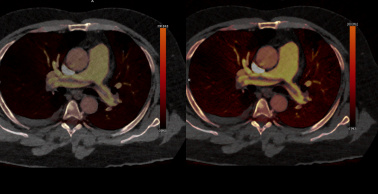
Intrinsic spectral imaging enabled direct quantification of iodine distribution, generating functional perfusion maps of the lung parenchyma. These maps facilitated the identification of perfusion deficits, aiding in the evaluation of conditions such as pulmonary embolism, interstitial lung disease, and chronic obstructive pulmonary disease (COPD).


Clinical Case Study 1
Free-Breathing Lung Imaging with Turbo Flash
Patient History and Objective
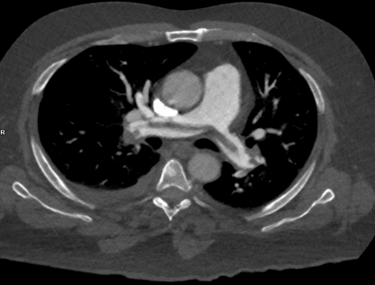
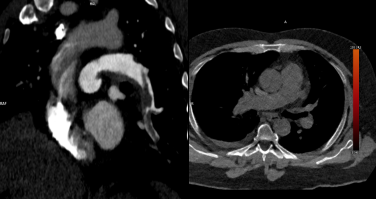
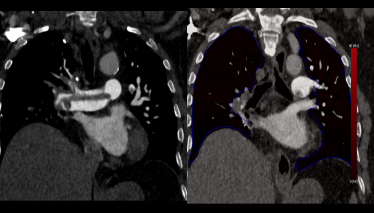
A 65-year-old male patient weighing 120 kg presented with breathing difficulties and recent-onset chest pain. The patient had no prior history of chest pain or related symptoms. Due to clinical suspicion of pulmonary embolism (PE), a CT pulmonary angiography (CTPA) study was recommended. Given the patient’s inability to hold their breath, a free-breathing imaging protocol was deemed essential to ensure diagnostic accuracy while addressing challenges related to his body habitus.
This study aimed to evaluate the feasibility and clinical impact of free-breathing lung imaging using the Turbo acquisition mode in PCCT, focusing on dose reduction, contrast optimization, and functional perfusion analysis.


Protocol
System: NAEOTOM Alpha® Photon-Counting CT Scanner (Siemens Healthineers, Germany).
Mode of Scan: Turbo Flash mode for ultrafast acquisition.
Contrast Administration:
• 60 mL of contrast medium at a flow rate of 5 mL/sec.
• Followed by 40 mL saline flush at a flow rate of 5 mL/sec.
• Reduced contrast dose protocol optimized for spectral imaging.
Patient Preparation
No breath-hold requirement, ensuring comfort for patients with limited compliance, particularly those experiencing respiratory distress.
Imaging Technique
Intrinsic spectral data acquisition was performed without the need for additional scan phases, enabling simultaneous anatomical and functional assessments.


Key Findings
Ultrafast and Free-Breathing Capability
The Turbo Flash mode eliminated the need for breath-holding, significantly enhancing patient comfort and scan feasibility, particularly for patients with compromised respiratory function. The dose-saving potential was especially advantageous for follow-up examinations and pediatric patients.
Functional Lung Perfusion Analysis
Intrinsic spectral imaging enabled direct quantification of iodine distribution, generating functional perfusion maps of the lung parenchyma. These maps facilitated the identification of perfusion deficits, aiding in the evaluation of conditions such as pulmonary embolism, interstitial lung disease, and chronic obstructive pulmonary disease (COPD).


Clinical Case Study 1
Free-Breathing Lung Imaging with Turbo Flash
Patient History and Objective
A 65-year-old male patient weighing 120 kg presented with breathing difficulties and recent-onset chest pain. The patient had no prior history of chest pain or related symptoms. Due to clinical suspicion of pulmonary embolism (PE), a CT pulmonary angiography (CTPA) study was recommended. Given the patient’s inability to hold their breath, a free-breathing imaging protocol was deemed essential to ensure diagnostic accuracy while addressing challenges related to his body habitus.
This study aimed to evaluate the feasibility and clinical impact of free-breathing lung imaging using the Turbo acquisition mode in PCCT, focusing on dose reduction, contrast optimization, and functional perfusion analysis.


Protocol
System: NAEOTOM Alpha® Photon-Counting CT Scanner (Siemens Healthineers, Germany).
Mode of Scan: Turbo Flash mode for ultrafast acquisition.
Contrast Administration:
• 60 mL of contrast medium at a flow rate of 5 mL/sec.
• Followed by 40 mL saline flush at a flow rate of 5 mL/sec.
• Reduced contrast dose protocol optimized for spectral imaging.
Patient Preparation
No breath-hold requirement, ensuring comfort for patients with limited compliance, particularly those experiencing respiratory distress.
Imaging Technique
Intrinsic spectral data acquisition was performed without the need for additional scan phases, enabling simultaneous anatomical and functional assessments.


Key Findings
Ultrafast and Free-Breathing Capability
The Turbo Flash mode eliminated the need for breath-holding, significantly enhancing patient comfort and scan feasibility, particularly for patients with compromised respiratory function. The dose-saving potential was especially advantageous for follow-up examinations and pediatric patients.
Functional Lung Perfusion Analysis
Intrinsic spectral imaging enabled direct quantification of iodine distribution, generating functional perfusion maps of the lung parenchyma. These maps facilitated the identification of perfusion deficits, aiding in the evaluation of conditions such as pulmonary embolism, interstitial lung disease, and chronic obstructive pulmonary disease (COPD).
Conclusion
Photon-counting CT imaging with the Turbo Flash acquisition mode represents a paradigm shift in lung imaging. By enabling free-breathing ultrafast scanning, reducing dose exposure, and providing intrinsic spectral data, this protocol improves both diagnostic capabilities and patient comfort.
The addition of functional perfusion assessment a new dimension to imaging, particularly for evaluating diffuse lung diseases and perfusion abnormalities. The integration of PCCT into routine clinical practice holds the promise of redefining standards in thoracic imaging, offering comprehensive, high-quality diagnostics while prioritizing patient safety and care.
Protocol
The Ultra-High-Resolution (UHR) imaging protocol on the NAEOTOM Alpha® Photon-Counting CT Scanner (Siemens Healthineers, Germany) represents a groundbreaking advancement in diagnostic imaging. This protocol harnesses the unique capabilities of photon-counting technology to achieve a slice thickness of 0.2 mm, delivering unmatched detail for visualizing fine anatomical structures with exceptional clarity. This protocol establishes a new standard for precision imaging, ensuring both superior diagnostic accuracy and patient safety.
Clinical Implications
1. Setting a new benchmark for Imaging Standards
• PCCT in low-dose, single-beat mode surpasses the diagnostic capabilities of conventional CT by providing unprecedented spatial and temporal resolution.
• The detailed visualization achieved is essential for managing complex cardiac and vascular cases.
2. Enhanced Functional and Anatomical Assessment
• Intrinsic spectral imaging integrates functional insights with high-resolution anatomy, enabling comprehensive evaluation in a single scan.
• Myocardial perfusion maps and plaque characterization broaden the diagnostic scope of cardiac imaging.
3. Improved Patient Outcomes
• The ability to detect subtle pathologies and early disease changes supports proactive management and treatment planning.
• Reduced radiation dose and contrast requirements align with patient-centric care models, enhancing safety for both routine and high-risk populations.

Clinical Case Study 2
Photon-Counting CT Imaging: Redefining Diagnostic Standards with Low-Dose Cardiac Imaging in Single-Beat Turbo Flash Mode with Full Spectral Capabilities
Photon-counting CT (PCCT) with Turbo Flash mode represents a groundbreaking advancement in cardiac imaging, combining ultra-high spatial and temporal resolution with intrinsic spectral capabilities—all at remarkably low radiation doses.
This study employed Turbo Flash single-beat acquisition to achieve a slice thickness of 0.4 mm, enabling exceptionally detailed visualization of cardiac anatomy. The ultra-fast imaging facilitated by Turbo Flash mode offers temporal resolution far superior to conventional CT systems, making it possible to perform single-beat cardiac imaging with comprehensive spectral data acquisition. Spectral analysis, and functional assessment.
Patient History and Objective:
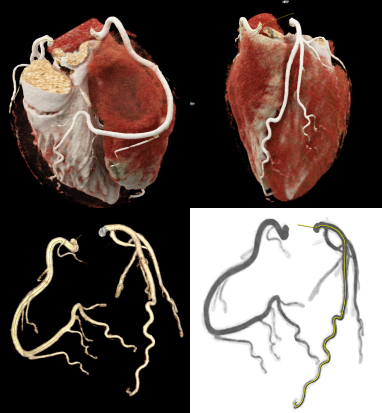
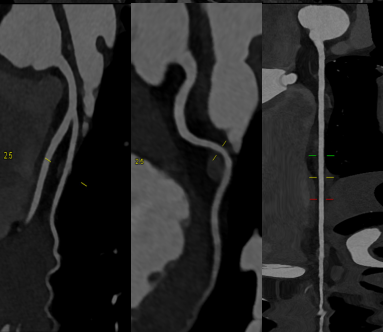
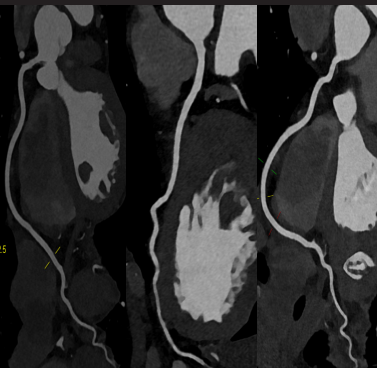
A 65-year-old male with a history of medically managed coronary artery disease, previously treated with stent placement, presented for a follow-up evaluation. The objective of the study was to assess stent patency and evaluate the surrounding vasculature for signs of restenosis or other abnormalities.
Given the patient’s clinical history, high-resolution imaging was deemed essential to provide detailed visualization of the stent and adjacent vascular structures, facilitating a comprehensive diagnostic assessment and guiding ongoing management.


Key Findings
This approach sets a new standard for evaluating vascular restenosis, offering precise visualization of coronary arteries, stents, and vascular walls. The ability to acquire both functional and anatomical data in a single, ultra-low-dose scan highlights the transformative potential of photon-counting CT (PCCT) in cardiac imaging.By combining unparalleled resolution, intrinsic spectral imaging, and ultra-fast acquisition, PCCT establishes a new benchmark for precision, safety, and diagnostic capability in cardiovascular care.
The ultra-low-dose imaging protocol on the photon-counting CT system has demonstrated revolutionary capabilities in advanced diagnostics. Intrinsic spectral data acquisition enables iodine quantification, providing functional perfusion maps of the myocardium. This facilitates the identification of regional perfusion deficits, which are critical for evaluating ischemic heart disease and myocardial pathologies. Spectral imaging capabilities further enhance diagnostic precision by differentiating calcified plaques from soft tissue, offering comprehensive insights into atherosclerotic disease progression. Collectively, these advancements underscore the transformative potential of photon-counting CT in redefining diagnostic standards for cardiovascular and vascular imaging.
Protocol
The Ultra-High-Resolution (UHR) imaging protocol on the NAEOTOM Alpha® Photon-Counting CT Scanner (Siemens Healthineers, Germany) represents a groundbreaking advancement in diagnostic imaging. This protocol harnesses the unique capabilities of photon-counting technology to achieve a slice thickness of 0.2 mm, delivering unmatched detail for visualizing fine anatomical structures with exceptional clarity. This protocol establishes a new standard for precision imaging, ensuring both superior diagnostic accuracy and patient safety.
Clinical Implications
1. Setting a new benchmark for Imaging Standards
• PCCT in low-dose, single-beat mode surpasses the diagnostic capabilities of conventional CT by providing unprecedented spatial and temporal resolution.
• The detailed visualization achieved is essential for managing complex cardiac and vascular cases.
2. Enhanced Functional and Anatomical Assessment
• Intrinsic spectral imaging integrates functional insights with high-resolution anatomy, enabling comprehensive evaluation in a single scan.
• Myocardial perfusion maps and plaque characterization broaden the diagnostic scope of cardiac imaging.
3. Improved Patient Outcomes
• The ability to detect subtle pathologies and early disease changes supports proactive management and treatment planning.
• Reduced radiation dose and contrast requirements align with patient-centric care models, enhancing safety for both routine and high-risk populations.

Clinical Case Study 2
Photon-Counting CT Imaging: Redefining Diagnostic Standards with Low-Dose Cardiac Imaging in Single-Beat Turbo Flash Mode with Full Spectral Capabilities
Photon-counting CT (PCCT) with Turbo Flash mode represents a groundbreaking advancement in cardiac imaging, combining ultra-high spatial and temporal resolution with intrinsic spectral capabilities—all at remarkably low radiation doses.
This study employed Turbo Flash single-beat acquisition to achieve a slice thickness of 0.4 mm, enabling exceptionally detailed visualization of cardiac anatomy. The ultra-fast imaging facilitated by Turbo Flash mode offers temporal resolution far superior to conventional CT systems, making it possible to perform single-beat cardiac imaging with comprehensive spectral data acquisition. Spectral analysis, and functional assessment.
Patient History and Objective:
A 65-year-old male with a history of medically managed coronary artery disease, previously treated with stent placement, presented for a follow-up evaluation. The objective of the study was to assess stent patency and evaluate the surrounding vasculature for signs of restenosis or other abnormalities.
Given the patient’s clinical history, high-resolution imaging was deemed essential to provide detailed visualization of the stent and adjacent vascular structures, facilitating a comprehensive diagnostic assessment and guiding ongoing management.


Key Findings
This approach sets a new standard for evaluating vascular restenosis, offering precise visualization of coronary arteries, stents, and vascular walls. The ability to acquire both functional and anatomical data in a single, ultra-low-dose scan highlights the transformative potential of photon-counting CT (PCCT) in cardiac imaging.By combining unparalleled resolution, intrinsic spectral imaging, and ultra-fast acquisition, PCCT establishes a new benchmark for precision, safety, and diagnostic capability in cardiovascular care.
The ultra-low-dose imaging protocol on the photon-counting CT system has demonstrated revolutionary capabilities in advanced diagnostics. Intrinsic spectral data acquisition enables iodine quantification, providing functional perfusion maps of the myocardium. This facilitates the identification of regional perfusion deficits, which are critical for evaluating ischemic heart disease and myocardial pathologies. Spectral imaging capabilities further enhance diagnostic precision by differentiating calcified plaques from soft tissue, offering comprehensive insights into atherosclerotic disease progression. Collectively, these advancements underscore the transformative potential of photon-counting CT in redefining diagnostic standards for cardiovascular and vascular imaging.
Protocol
The Ultra-High-Resolution (UHR) imaging protocol on the NAEOTOM Alpha® Photon-Counting CT Scanner (Siemens Healthineers, Germany) represents a groundbreaking advancement in diagnostic imaging. This protocol harnesses the unique capabilities of photon-counting technology to achieve a slice thickness of 0.2 mm, delivering unmatched detail for visualizing fine anatomical structures with exceptional clarity. This protocol establishes a new standard for precision imaging, ensuring both superior diagnostic accuracy and patient safety.
Clinical Implications
1. Setting a new benchmark for Imaging Standards
• PCCT in low-dose, single-beat mode surpasses the diagnostic capabilities of conventional CT by providing unprecedented spatial and temporal resolution.
• The detailed visualization achieved is essential for managing complex cardiac and vascular cases.
2. Enhanced Functional and Anatomical Assessment
• Intrinsic spectral imaging integrates functional insights with high-resolution anatomy, enabling comprehensive evaluation in a single scan.
• Myocardial perfusion maps and plaque characterization broaden the diagnostic scope of cardiac imaging.
3. Improved Patient Outcomes
• The ability to detect subtle pathologies and early disease changes supports proactive management and treatment planning.
• Reduced radiation dose and contrast requirements align with patient-centric care models, enhancing safety for both routine and high-risk populations.

Conclusion
In conclusion, photon-counting CT with ultra-low-dose, high-pitch Turbo Flash single-beat imaging represents a transformative advancement in cardiac diagnostics. This innovative approach delivers unmatched spatial and temporal resolution with very low-dose delivery, enabling precise visualization of cardiac structures and functional assessment in a single heartbeat. The capability to acquire high-quality, motion-free images with a sub-millisievert radiation dose ensures patient safety without compromising diagnostic accuracy.
Intrinsic spectral imaging further enhances the protocol by providing detailed insights into myocardial perfusion, plaque characterization, and vascular health. By combining ultra-fast acquisition with comprehensive spectral data, photon-counting CT establishes a new gold standard in cardiac imaging, offering unprecedented precision, efficiency, and safety for both routine and complex clinical cases.
"Photon-counting CT with ultra-low-dose, high-pitch Turbo Flash single-beat imaging represents a transformative advancement in cardiac diagnostics."

Al Ahli hospital, Qatar
"Intrinsic spectral imaging further enhances the protocol by providing detailed insights into myocardial perfusion, plaque characterization, and vascular health."

Al Ahli hospital, Qatar
