Introduction
Sophisticated imaging demands must be fulfilled to ensure a tailored diagnostic and clinical procedure and better patient outcomes. Dual-source dual-energy systems revolutionized the field of cardiac imaging, in all its indications, by enabling native temporal resolution with sub-second scanning, thanks to the simultaneous maximum rotation speed at the highest pitch. This unparalleled technology can uniquely attain images confidently in the most challenging clinical conditions.
Cardiovascular care and related imaging requirements have dramatically changed in the recent past. Historically, the standard was simple coronary imaging, which has progressively evolved to the demand for a broad spectrum of imaging techniques, including structural heart imaging (~160,000 transcatheter and LAAC procedures), heart failure imaging (~23 million patients), coronary artery imaging (~4,800,000 PCI procedures, ~7,000,000 diagnostic procedures), coronary artery imaging with variable heart rhythms (bradycardia, tachycardia, arrhythmia), pediatric cardiac imaging, thoracic vessel evaluation, ultra low dose lung cancer screening, 3D printing, photorealistic imaging, robotic, and surgical imaging.
Sophisticated imaging demands must be fulfilled to ensure a tailored diagnostic and clinical procedure and better patient outcomes. Dual-source dual-energy systems revolutionized the field of cardiac imaging, in all its indications, by enabling native temporal resolution with sub-second scanning, thanks to the simultaneous maximum rotation speed at the highest pitch. This unparalleled technology can uniquely attain images confidently in the most challenging clinical conditions.
Cardiovascular care and related imaging requirements have dramatically changed in the recent past. Historically, the standard was simple coronary imaging, which has progressively evolved to the demand for a broad spectrum of imaging techniques, including structural heart imaging (~160,000 transcatheter and LAAC procedures), heart failure imaging (~23 million patients), coronary artery imaging (~4,800,000 PCI procedures, ~7,000,000 diagnostic procedures), coronary artery imaging with variable heart rhythms (bradycardia, tachycardia, arrhythmia), pediatric cardiac imaging, thoracic vessel evaluation, ultra low dose lung cancer screening, 3D printing, photorealistic imaging, robotic, and surgical imaging.
Sophisticated imaging demands must be fulfilled to ensure a tailored diagnostic and clinical procedure and better patient outcomes. Dual-source dual-energy systems revolutionized the field of cardiac imaging, in all its indications, by enabling native temporal resolution with sub-second scanning, thanks to the simultaneous maximum rotation speed at the highest pitch. This unparalleled technology can uniquely attain images confidently in the most challenging clinical conditions.
Scanning Technique
AI-based algorithms with DSCT techniques ensure the highest image quality with the lowest achievable dose. In addition, automatic exposure control for kV and mAs settings is the key to reducing contrast amount and dose on a patient-specific basis.
Patients have been scanned on the Siemens Healthineers SOMATOM Force dual-source CT (DSCT) scanner equipped with the state-of-the-art AI-based advanced cardiac package, including adaptive perspective acquisition (CorAdSeq), adaptive retrospective modeling, prospective ECG-triggered sequence, and Turbo Flash protocols.
AI-based algorithms with DSCT techniques ensure the highest image quality with the lowest achievable dose. In addition, automatic exposure control for kV and mAs settings is the key to reducing contrast amount and dose on a patient-specific basis.
Patients have been scanned on the Siemens Healthineers SOMATOM Force dual-source CT (DSCT) scanner equipped with the state-of-the-art AI-based advanced cardiac package, including adaptive perspective acquisition (CorAdSeq), adaptive retrospective modeling, prospective ECG-triggered sequence, and Turbo Flash protocols.
AI-based algorithms with DSCT techniques ensure the highest image quality with the lowest achievable dose. In addition, automatic exposure control for kV and mAs settings is the key to reducing contrast amount and dose on a patient-specific basis.
Case Study 1
Pediatric Congenital Anomaly Imaging
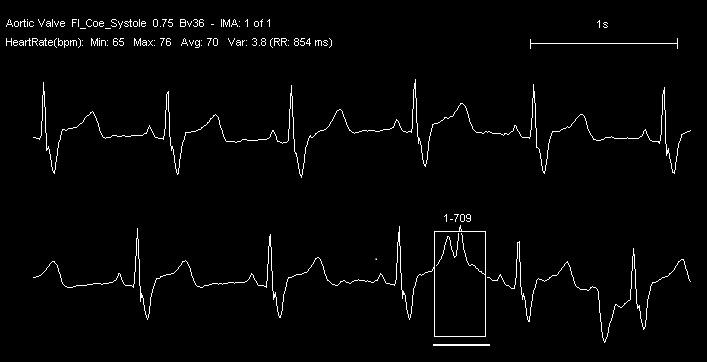
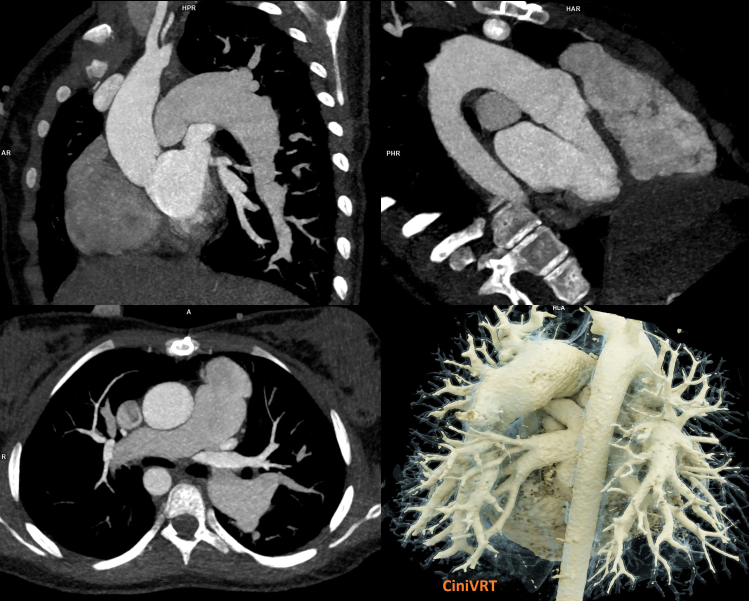
Turbo Flash mode with high-pitch enables a free-breathing, sub-second acquisition protocol. The scan length is 252.1 mm, covered in 0.41 sec scan time. The total DLP is 55 mGy*cm. Siemens CARE child solution allows performing the acquisition at 70 kV and 300
mAs, reducing the total effective dose to 0.9 mSv (with a conversion factor of 0.018).
History
A pediatric patient presents for post-Fallot repair follow-up with a recommendation for no sedation and free-breathing imaging.
Turbo Flash mode with high-pitch enables a free-breathing, sub-second acquisition protocol. The scan length is 252.1 mm, covered in 0.41 sec scan time. The total DLP is 55 mGy*cm. Siemens CARE child solution allows performing the acquisition at 70 kV and 300
mAs, reducing the total effective dose to 0.9 mSv (with a conversion factor of 0.018).
Impression
Evidence of residual infundibular pulmonary stenosis is observed. In addition, images demonstrate dilated central pulmonary arteries predominantly to the left side and dilated ascending aorta with a right-sided aortic arch.

Turbo Flash mode with high-pitch enables a free-breathing, sub-second acquisition protocol. The scan length is 252.1 mm, covered in 0.41 sec scan time. The total DLP is 55 mGy*cm. Siemens CARE child solution allows performing the acquisition at 70 kV and 300
mAs, reducing the total effective dose to 0.9 mSv (with a conversion factor of 0.018).
History
A pediatric patient presents for post-Fallot repair follow-up with a recommendation for no sedation and free-breathing imaging.
Turbo Flash mode with high-pitch enables a free-breathing, sub-second acquisition protocol. The scan length is 252.1 mm, covered in 0.41 sec scan time. The total DLP is 55 mGy*cm. Siemens CARE child solution allows performing the acquisition at 70 kV and 300
mAs, reducing the total effective dose to 0.9 mSv (with a conversion factor of 0.018).
Impression
Evidence of residual infundibular pulmonary stenosis is observed. In addition, images demonstrate dilated central pulmonary arteries predominantly to the left side and dilated ascending aorta with a right-sided aortic arch.

Turbo Flash mode with high-pitch enables a free-breathing, sub-second acquisition protocol. The scan length is 252.1 mm, covered in 0.41 sec scan time. The total DLP is 55 mGy*cm. Siemens CARE child solution allows performing the acquisition at 70 kV and 300
mAs, reducing the total effective dose to 0.9 mSv (with a conversion factor of 0.018).
History
A pediatric patient presents for post-Fallot repair follow-up with a recommendation for no sedation and free-breathing imaging.
Case Study 2
Single-Beat Atrial Fibrillation imaging
40 ml of contrast media is injected at a rate of 5.5 ml/sec. A Turbo Flash, high-pitch, single beat sub-second acquisition is performed at a CT dose index of 1.62 mGy and a total DLP of 89 mGy*cm. The scan length is 150.9 mm, covered in 0.3 sec scan time. Siemens CARE Dose 4D and CARD kV solutions allow performing the study with low contrast medium volume at 70 kV and 405 mAs, reducing the total effective dose to 1.24 mSv (with a
conversion factor of 0.014).
Impression
A Turbo Flash-enabled, single-beat CT coronary angiography reveals normal coronary anatomy, with a nomenclature dominant RCA and a non-significant small myocardial bridging with the LAD.

40 ml of contrast media is injected at a rate of 5.5 ml/sec. A Turbo Flash, high-pitch, single beat sub-second acquisition is performed at a CT dose index of 1.62 mGy and a total DLP of 89 mGy*cm. The scan length is 150.9 mm, covered in 0.3 sec scan time. Siemens CARE Dose 4D and CARD kV solutions allow performing the study with low contrast medium volume at 70 kV and 405 mAs, reducing the total effective dose to 1.24 mSv (with a
conversion factor of 0.014).
History
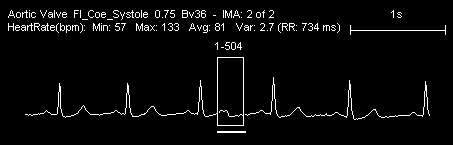
A patient suffering from hypertension presents to the emergency department with atypical chest pain and atrial fibrillation (irregular heart rate ranging from 55 to 103 BPM).
40 ml of contrast media is injected at a rate of 5.5 ml/sec. A Turbo Flash, high-pitch, single beat sub-second acquisition is performed at a CT dose index of 1.62 mGy and a total DLP of 89 mGy*cm. The scan length is 150.9 mm, covered in 0.3 sec scan time. Siemens CARE Dose 4D and CARD kV solutions allow performing the study with low contrast medium volume at 70 kV and 405 mAs, reducing the total effective dose to 1.24 mSv (with a
conversion factor of 0.014).
Impression
A Turbo Flash-enabled, single-beat CT coronary angiography reveals normal coronary anatomy, with a nomenclature dominant RCA and a non-significant small myocardial bridging with the LAD.

40 ml of contrast media is injected at a rate of 5.5 ml/sec. A Turbo Flash, high-pitch, single beat sub-second acquisition is performed at a CT dose index of 1.62 mGy and a total DLP of 89 mGy*cm. The scan length is 150.9 mm, covered in 0.3 sec scan time. Siemens CARE Dose 4D and CARD kV solutions allow performing the study with low contrast medium volume at 70 kV and 405 mAs, reducing the total effective dose to 1.24 mSv (with a
conversion factor of 0.014).
History
A patient suffering from hypertension presents to the emergency department with atypical chest pain and atrial fibrillation (irregular heart rate ranging from 55 to 103 BPM).
40 ml of contrast media is injected at a rate of 5.5 ml/sec. A Turbo Flash, high-pitch, single beat sub-second acquisition is performed at a CT dose index of 1.62 mGy and a total DLP of 89 mGy*cm. The scan length is 150.9 mm, covered in 0.3 sec scan time. Siemens CARE Dose 4D and CARD kV solutions allow performing the study with low contrast medium volume at 70 kV and 405 mAs, reducing the total effective dose to 1.24 mSv (with a
conversion factor of 0.014).
Impression
A Turbo Flash-enabled, single-beat CT coronary angiography reveals normal coronary anatomy, with a nomenclature dominant RCA and a non-significant small myocardial bridging with the LAD.
Case Study 3
Free-Breathing Pulmonary Emboli Imaging
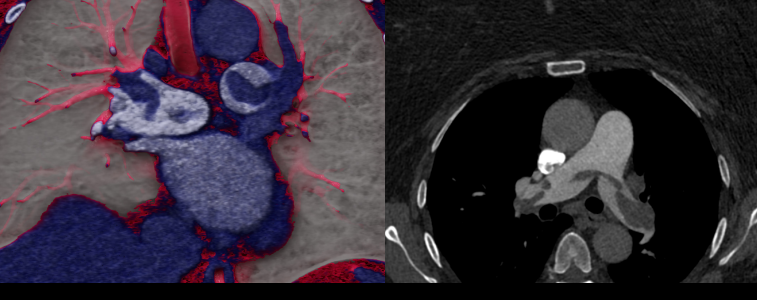
30 ml of contrast media is injected at a rate of 5.5 ml/sec. A Turbo Flash, high-pitch, sub-second acquisition is performed at a CT dose index of 1.62 mGy and a total DLP of 89 mGy*cm. The scan length is 150.9 mm, covered in 0.3 sec scan time. Siemens CARE Dose 4D and CARD kV solutions allow performing the study with low contrast medium volume at 70 kV and 405 mAs, reducing the total effective dose to 1.24 mSv (with a conversion factor
of 0.014).
Impression
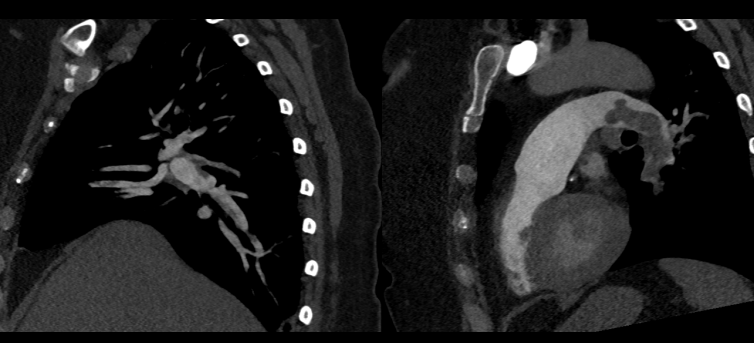
A venous doppler highlighted subacute deep vein thrombosis of the right LL. The CT scan visualized a saddle-shaped, massive pulmonary embolism.
30 ml of contrast media is injected at a rate of 5.5 ml/sec. A Turbo Flash, high-pitch, sub-second acquisition is performed at a CT dose index of 1.62 mGy and a total DLP of 89 mGy*cm. The scan length is 150.9 mm, covered in 0.3 sec scan time. Siemens CARE Dose 4D and CARD kV solutions allow performing the study with low contrast medium volume at 70 kV and 405 mAs, reducing the total effective dose to 1.24 mSv (with a conversion factor
of 0.014).
History
A patient suffering from high blood pressure, diabetes mellitus, and with BMI of 33 presents with acute shortness of breath, tachycardia, and right lower limb edema.
30 ml of contrast media is injected at a rate of 5.5 ml/sec. A Turbo Flash, high-pitch, sub-second acquisition is performed at a CT dose index of 1.62 mGy and a total DLP of 89 mGy*cm. The scan length is 150.9 mm, covered in 0.3 sec scan time. Siemens CARE Dose 4D and CARD kV solutions allow performing the study with low contrast medium volume at 70 kV and 405 mAs, reducing the total effective dose to 1.24 mSv (with a conversion factor
of 0.014).
Impression
A venous doppler highlighted subacute deep vein thrombosis of the right LL. The CT scan visualized a saddle-shaped, massive pulmonary embolism.
30 ml of contrast media is injected at a rate of 5.5 ml/sec. A Turbo Flash, high-pitch, sub-second acquisition is performed at a CT dose index of 1.62 mGy and a total DLP of 89 mGy*cm. The scan length is 150.9 mm, covered in 0.3 sec scan time. Siemens CARE Dose 4D and CARD kV solutions allow performing the study with low contrast medium volume at 70 kV and 405 mAs, reducing the total effective dose to 1.24 mSv (with a conversion factor
of 0.014).
History
A patient suffering from high blood pressure, diabetes mellitus, and with BMI of 33 presents with acute shortness of breath, tachycardia, and right lower limb edema.
30 ml of contrast media is injected at a rate of 5.5 ml/sec. A Turbo Flash, high-pitch, sub-second acquisition is performed at a CT dose index of 1.62 mGy and a total DLP of 89 mGy*cm. The scan length is 150.9 mm, covered in 0.3 sec scan time. Siemens CARE Dose 4D and CARD kV solutions allow performing the study with low contrast medium volume at 70 kV and 405 mAs, reducing the total effective dose to 1.24 mSv (with a conversion factor
of 0.014).
Impression
A venous doppler highlighted subacute deep vein thrombosis of the right LL. The CT scan visualized a saddle-shaped, massive pulmonary embolism.
Conclusion
Traditional CT coronary imaging gradually matured into comprehensive cardiac imaging protocols in the recent past with the support of emerging technologies. As a result, advanced CT cardiac imaging has developed into the preferred test used to diagnose various heart conditions, thanks to its noninvasive nature and absence of a recovery time. The non-invasive, high-quality depiction of cardiac anatomy and pathology is no longer an excellent challenge for computed tomography. Intrinsic temporal resolution, high pitch, and dual-source technology, with its fastest rotation time, allow us to perform cardiac imagining without any physiological limitations. In addition, dual-source CT technological development, including hardware and AI-based software solutions, allows for overcoming the past challenges of comprehensive cardiac computed tomography imaging.
Contact

Dr. Ibrahim Helmy
Head of the Radiology Department in NHI
National Heart Institute, Giza, Egypt
Dr. Reem Ramadan
Consultant of Radiology
National Heart Institute, Giza, Egypt
Dr. Yousra Mahmoud
Assistant fellow of Radiology
National Heart Institute, Giza, Egypt
Dr. Ali Hassan
Radiology Specialist
National Heart Institute, Giza, Egypt