Teaching Point 2
Lutetium emits a low level of gamma rays, which can be visualized using a SPECT machine. This allows for confirmation of therapeutic drug delivery to the target tumor cells.
Post-Therapy
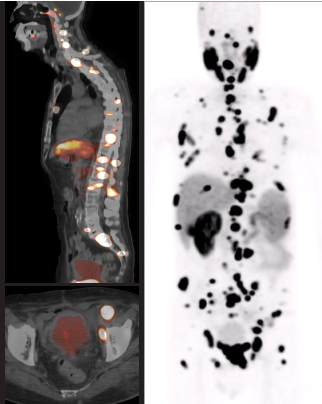
A follow-up Ga-PSMA PET/CT scan performed 6 months after the initiation of therapy (Fig. 3) reveals complete resolution of the metastatic lymph nodes and significant regression of the metastatic bone lesions, indicating a robust therapeutic response. Additionally, the patient’s tumor marker level (PSA) decreased by an impressive 94%, from 283 ng/mL before therapy to 18 ng/mL, highlighting the effectiveness of the treatment. Clinically, the patient has reported a marked improvement in quality of life, with complete resolution of bone pain that had previously hindered his daily functioning. He is now able to resume his normal activities without limitations, reflecting the profound impact of the therapy on both his physical well-being and overall lifestyle.
Teaching Point 3
Lutetium-PSMA is a radioactive therapy used for patients with metastatic prostate cancer. It has been shown to prolong survival, significantly improve quality of life, and is associated with low side effects.


Patient History
We present the case of a 74-year-old male patient diagnosed with metastatic, hormone-resistant prostate cancer, a challenging condition with limited treatment options. The patient had a history of undergoing hormonal therapy with Abiraterone, which initially helped manage his disease, but he eventually developed resistance.
Additionally, he underwent chemotherapy with Docetaxel, a standard treatment for advanced prostate cancer, but his disease progressed despite these interventions. His clinical course highlights the complexities of managing hormone-resistant prostate cancer and underscores the need for novel therapeutic approaches to improve outcomes for patients with this aggressive disease.
Pre-Therapy Scan
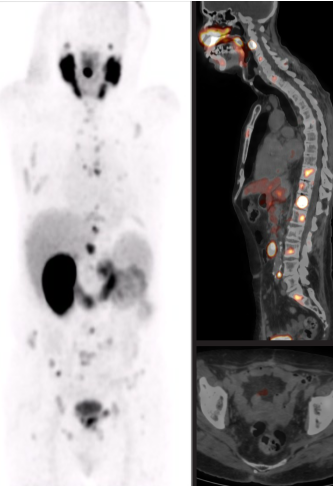
The patient’s baseline Ga-PSMA PET/CT scan (Fig.1) revealed widespread metastatic involvement, including diffuse lymph nodes and bony lesions, both exhibiting high PSMA uptake. These findings confirmed the patient’s eligibility for targeted radioligand therapy.
Teaching Point 1
The Ga-PSMA PET/CT scan is a comprehensive whole-body imaging modality capable of detecting all sites of prostate cancer deposits in a single examination, including local recurrence, nodal involvement, bony metastases, and visceral deposits.
The Procedure
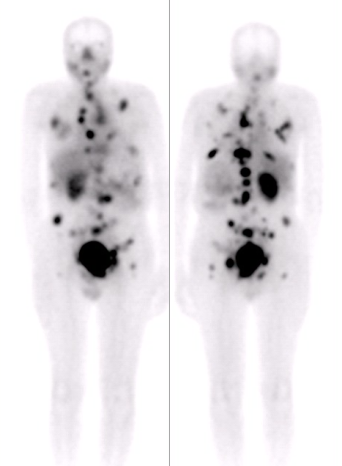
The patient received two intravenous therapeutic doses of Lutetium-PSMA, administered two months apart as part of his treatment plan for metastatic, hormone-resistant prostate cancer. The images in Fig. 2 illustrate anterior and posterior SPECT views taken 5 hours after the injection of the first dose of Lutetium-PSMA, providing valuable insights into the therapy’s mechanism of action. These images demonstrate excellent tracer accumulation in the tumor cells, highlighting the high affinity of Lutetium-PSMA for PSMA-expressing cancer cells. The distribution of the tracer closely mirrors the tumoral distribution observed in the pre-therapy PSMA-PET/CT scan, confirming effective targeting of metastatic lesions and underscoring the potential of this therapy for precise tumor eradication.

Teaching Point 2
Lutetium emits a low level of gamma rays, which can be visualized using a SPECT machine. This allows for confirmation of therapeutic drug delivery to the target tumor cells.
Post-Therapy
A follow-up Ga-PSMA PET/CT scan performed 6 months after the initiation of therapy (Fig. 3) reveals complete resolution of the metastatic lymph nodes and significant regression of the metastatic bone lesions, indicating a robust therapeutic response. Additionally, the patient’s tumor marker level (PSA) decreased by an impressive 94%, from 283 ng/mL before therapy to 18 ng/mL, highlighting the effectiveness of the treatment. Clinically, the patient has reported a marked improvement in quality of life, with complete resolution of bone pain that had previously hindered his daily functioning. He is now able to resume his normal activities without limitations, reflecting the profound impact of the therapy on both his physical well-being and overall lifestyle.
Teaching Point 3
Lutetium-PSMA is a radioactive therapy used for patients with metastatic prostate cancer. It has been shown to prolong survival, significantly improve quality of life, and is associated with low side effects.


Patient History
We present the case of a 74-year-old male patient diagnosed with metastatic, hormone-resistant prostate cancer, a challenging condition with limited treatment options. The patient had a history of undergoing hormonal therapy with Abiraterone, which initially helped manage his disease, but he eventually developed resistance.
Additionally, he underwent chemotherapy with Docetaxel, a standard treatment for advanced prostate cancer, but his disease progressed despite these interventions. His clinical course highlights the complexities of managing hormone-resistant prostate cancer and underscores the need for novel therapeutic approaches to improve outcomes for patients with this aggressive disease.
Pre-Therapy Scan
The patient’s baseline Ga-PSMA PET/CT scan (Fig.1) revealed widespread metastatic involvement, including diffuse lymph nodes and bony lesions, both exhibiting high PSMA uptake. These findings confirmed the patient’s eligibility for targeted radioligand therapy.
Teaching Point 1
The Ga-PSMA PET/CT scan is a comprehensive whole-body imaging modality capable of detecting all sites of prostate cancer deposits in a single examination, including local recurrence, nodal involvement, bony metastases, and visceral deposits.
The Procedure
The patient received two intravenous therapeutic doses of Lutetium-PSMA, administered two months apart as part of his treatment plan for metastatic, hormone-resistant prostate cancer. The images in Fig. 2 illustrate anterior and posterior SPECT views taken 5 hours after the injection of the first dose of Lutetium-PSMA, providing valuable insights into the therapy’s mechanism of action. These images demonstrate excellent tracer accumulation in the tumor cells, highlighting the high affinity of Lutetium-PSMA for PSMA-expressing cancer cells. The distribution of the tracer closely mirrors the tumoral distribution observed in the pre-therapy PSMA-PET/CT scan, confirming effective targeting of metastatic lesions and underscoring the potential of this therapy for precise tumor eradication.

Teaching Point 2
Lutetium emits a low level of gamma rays, which can be visualized using a SPECT machine. This allows for confirmation of therapeutic drug delivery to the target tumor cells.
Post-Therapy
A follow-up Ga-PSMA PET/CT scan performed 6 months after the initiation of therapy (Fig. 3) reveals complete resolution of the metastatic lymph nodes and significant regression of the metastatic bone lesions, indicating a robust therapeutic response. Additionally, the patient’s tumor marker level (PSA) decreased by an impressive 94%, from 283 ng/mL before therapy to 18 ng/mL, highlighting the effectiveness of the treatment. Clinically, the patient has reported a marked improvement in quality of life, with complete resolution of bone pain that had previously hindered his daily functioning. He is now able to resume his normal activities without limitations, reflecting the profound impact of the therapy on both his physical well-being and overall lifestyle.
Teaching Point 3
Lutetium-PSMA is a radioactive therapy used for patients with metastatic prostate cancer. It has been shown to prolong survival, significantly improve quality of life, and is associated with low side effects.
References:
• U.S. Food and Drug Administration. “FDA approves first PSMA-targeted PET imaging drug for men with prostate cancer.” Available at: https://www.fda.gov/news-events/press announcements/fda-approves-first-psma-targeted-pet-imaging-drug-men-prostate-cancer.
• Hofman, Michael S., et al. “Prostate-specific membrane antigen PET-CT in patients with high-risk prostate cancer before curative-intent surgery or radiotherapy (proPSMA): a prospective, randomized, multicenter study.” Lancet (London, England) 395, no. 10231 (2020): 1208-1216. doi:10.1016/S0140-6736(20)30314-7.
• U.S. Food and Drug Administration. “FDA approves Pluvicto for metastatic castration-resistant prostate cancer.” Available at: https://www.fda.gov/drugs/resources-information-approved-drugs/fda-approves-pluvicto-metastatic-castration-resistant-prostate-cancer.
• Sartor, Oliver, et al. “Lutetium-177-PSMA-617 for metastatic castration-resistant prostate cancer.” The New England Journal of Medicine 385, no. 12 (2021): 1091-1103.doi:10.1056/NEJMoa2107322.
"Lutetium-PSMA is a radioactive therapy used for patients with metastatic prostate cancer. It has been shown to prolong survival, significantly improve quality of life, and is associated with low side effects."

Misr Radiology Center, Egypt